> ## Documentation Index
> Fetch the complete documentation index at: https://docs.open-metadata.org/llms.txt
> Use this file to discover all available pages before exploring further.
# AzureSQL | OpenMetadata Connector Setup & Integration Guide
> Learn how to connect Azure SQL OpenMetadata to OpenMetadata with step-by-step setup guides, configuration options, and metadata extraction features.
export const MetadataIngestionUi = ({connector, selectServicePath, addNewServicePath, serviceConnectionPath}) => {
return <>
To ingest metadata from your sources, you need to create a service connection.
The service connects your source system with OpenMetadata. Once you create
a service, you can use it to configure your ingestion workflows.
To create a service connection and ingest your metadata, follow the steps below:
-
On the left navigation bar, click Settings.
-
On the next page, click Services, and then select the service.
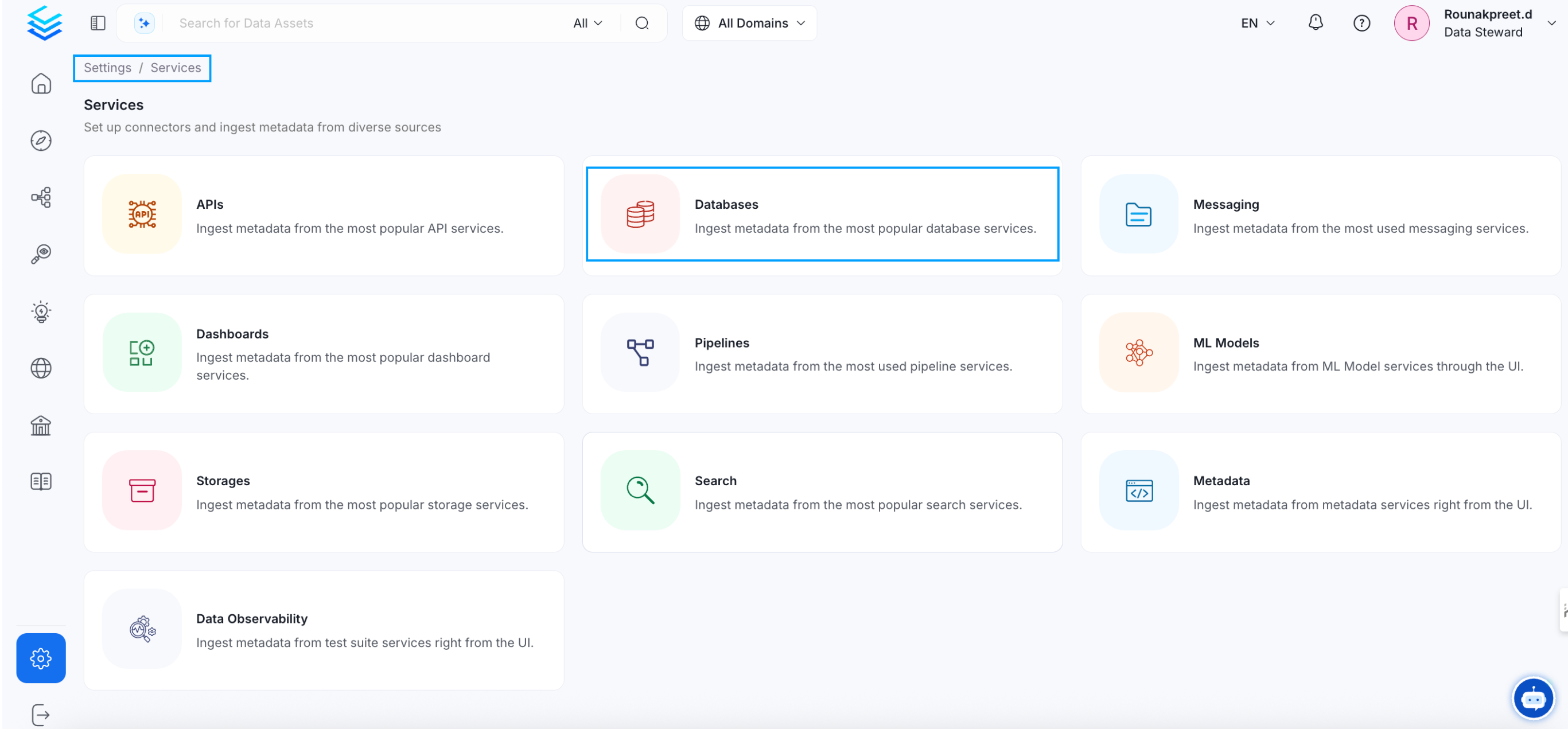
To add a new service connection, click Add New Service.
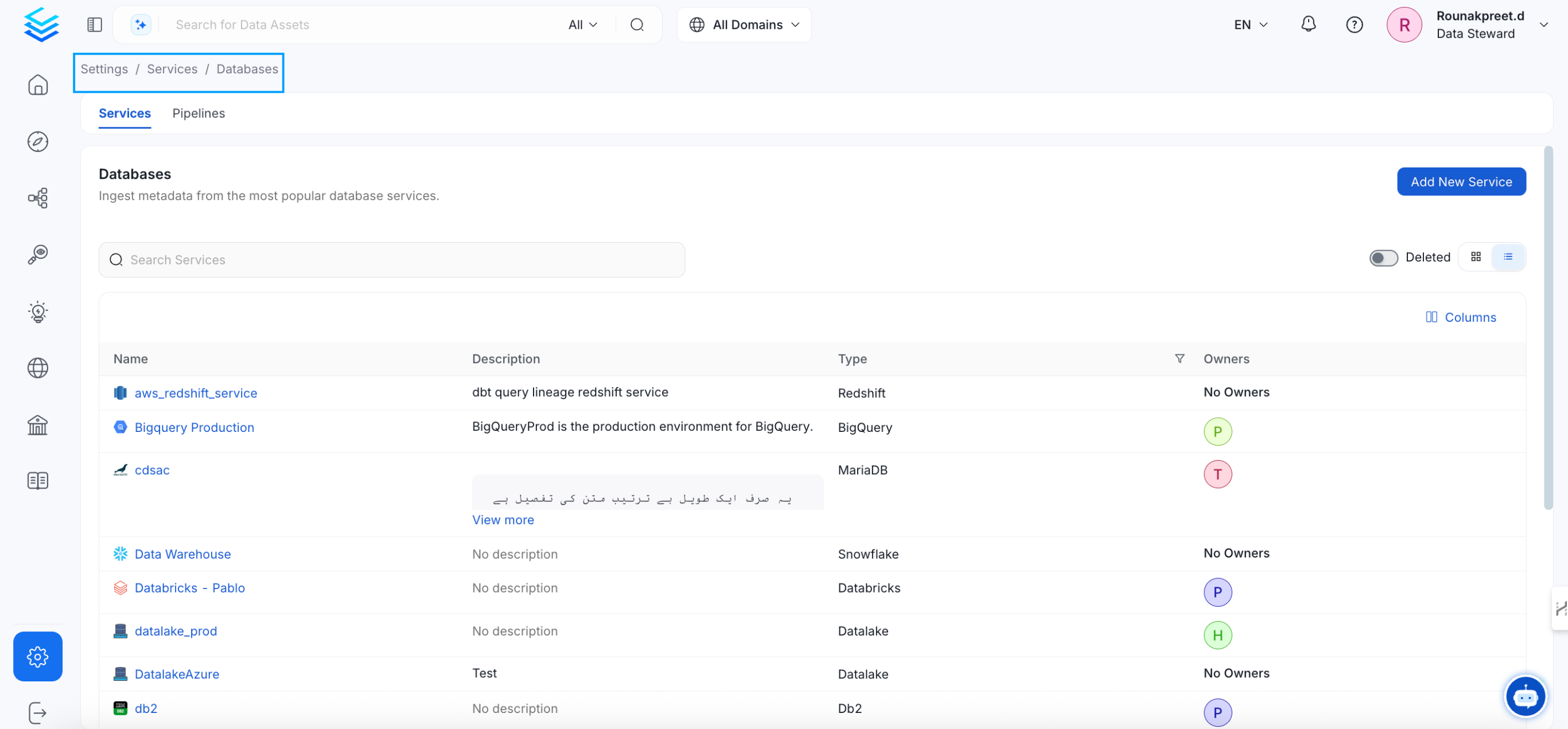 Select {connector} as the service type and click Next.
{selectServicePath &&
Select {connector} as the service type and click Next.
{selectServicePath &&  }
Enter a unique Service Name and Description.
}
Enter a unique Service Name and Description.
- Service Name: OpenMetadata identifies services by their service name. Enter a name that distinguishes this deployment from other services, including other {connector} services you are ingesting metadata from.
The service name cannot be changed after it is set.
{addNewServicePath &&  }
Set up the connection settings required for {connector} to set up the service and start ingesting metadata from your sources. The right-hand panel displays help documentation for the selected connection type in the product UI.
{serviceConnectionPath &&
}
Set up the connection settings required for {connector} to set up the service and start ingesting metadata from your sources. The right-hand panel displays help documentation for the selected connection type in the product UI.
{serviceConnectionPath &&  }
;
};
export const ConnectorDetailsHeader = ({name, icon, stage, availableFeatures, unavailableFeatures = [], availableFeaturesCollate = []}) => {
const showSubHeading = availableFeatures?.length > 0 || unavailableFeatures?.length > 0 || availableFeaturesCollate?.length > 0;
const totalAvailableFeatures = [...availableFeatures || [], ...availableFeaturesCollate || []];
return
}
;
};
export const ConnectorDetailsHeader = ({name, icon, stage, availableFeatures, unavailableFeatures = [], availableFeaturesCollate = []}) => {
const showSubHeading = availableFeatures?.length > 0 || unavailableFeatures?.length > 0 || availableFeaturesCollate?.length > 0;
const totalAvailableFeatures = [...availableFeatures || [], ...availableFeaturesCollate || []];
return
{icon &&
}
{name}
{stage}
{showSubHeading &&
Feature List
{totalAvailableFeatures.map(feature =>
✓ {feature}
)}
{unavailableFeatures.map(feature =>
✕ {feature}
)}
}
;
};
In this section, we provide guides and references to use the AzureSQL connector.
Configure and schedule AzureSQL metadata and profiler workflows from the OpenMetadata UI:
* [Requirements](#requirements)
* [Metadata Ingestion](#metadata-ingestion)
* [Service Name](#service-name)
* [Connection Options](#connection-options)
* [Metadata Ingestion Options](#metadata-ingestion-options)
* [Data Lineage](/v1.12.x/how-to-guides/data-lineage/workflow)
* [Troubleshooting](/v1.12.x/connectors/database/azuresql/troubleshooting)
* [Workflow Deployment Error](#workflow-deployment-error)
* [Related](#related)
## Requirements
Make sure if you have whitelisted ingestion container IP on Azure SQL firewall rules. Checkout [this](https://learn.microsoft.com/en-us/azure/azure-sql/database/firewall-configure?view=azuresql#use-the-azure-portal-to-manage-server-level-ip-firewall-rules) document on how to whitelist your IP using azure portal.
AzureSQL database user must grant `SELECT` privilege to fetch the metadata of tables and views.
```sql theme={null}
-- Create a new user
-- More details https://learn.microsoft.com/en-us/sql/t-sql/statements/create-user-transact-sql?view=sql-server-ver16
CREATE USER Mary WITH PASSWORD = '********';
-- Grant SELECT on table
GRANT SELECT TO Mary;
```
## Metadata Ingestion
# Connection Options
* **Username**: Specify the User to connect to AzureSQL. It should have enough privileges to read all the metadata.
* **Password**: Password to connect to AzureSQL.
* **Host and Port**: Enter the fully qualified hostname and port number for your AzureSQL deployment in the Host and Port field.
* **Database**: The database of the data source is an optional parameter, if you would like to restrict the metadata reading to a single database. If left blank, OpenMetadata ingestion attempts to scan all the databases.
* **Driver**: Connecting to AzureSQL requires ODBC driver to be installed. Specify ODBC driver name in the field.
You can download the ODBC driver from [here](https://learn.microsoft.com/en-us/sql/connect/odbc/download-odbc-driver-for-sql-server?view=sql-server-ver16). In case of docker or kubernetes deployment this driver comes out of the box with version `ODBC Driver 18 for SQL Server`.
**Authentication Mode**:
* **Authentication**:
* The `authentication` parameter determines the method of authentication when connecting to AzureSQL using ODBC (Open Database Connectivity).
* If you select **"Active Directory Password"**, you'll need to provide the password associated with your Azure Active Directory account.
* Alternatively, if you choose **"Active Directory Integrated"**, the connection will use the credentials of the currently logged-in user. This mode ensures secure and seamless connections with AzureSQL.
* **Encrypt**:
* The `encrypt` setting in the connection string pertains to data encryption during communication with AzureSQL.
* When enabled, it ensures that data exchanged between your application and the database is encrypted, enhancing security.
* **Trust Server Certificate**:
* The `trustServerCertificate` option also relates to security.
* When set to true, your application will trust the server's SSL certificate without validation. Use this cautiously, as it bypasses certificate validation checks.
* **Connection Timeout**:
* The `connectionTimeout` parameter specifies the maximum time (in seconds) that your application will wait while attempting to establish a connection to AzureSQL.
* If the connection cannot be established within this timeframe, an error will be raised.
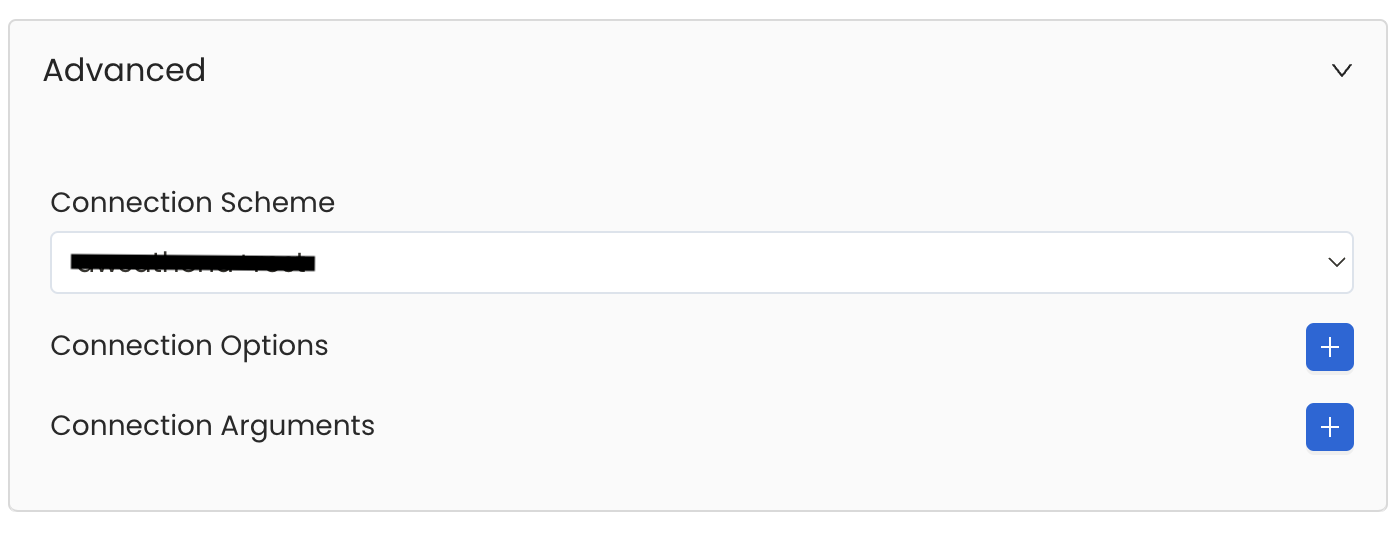
Database Services have an Advanced Configuration section, where you can pass extra arguments to the connector
and, if needed, change the connection Scheme.
This would only be required to handle advanced connectivity scenarios or customizations.
* **Connection Options (Optional)**: Enter the details for any additional connection options that can be sent to database during the connection. These details must be added as Key-Value pairs.
* **Connection Arguments (Optional)**: Enter the details for any additional connection arguments such as security or protocol configs that can be sent during the connection. These details must be added as Key-Value pairs.
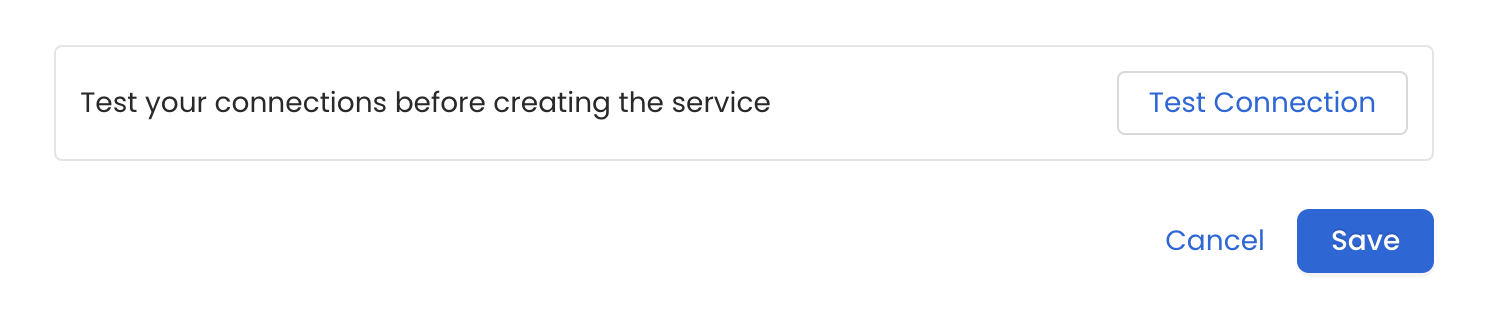
 Once the credentials have been added, click on *Test Connection* and *Save* the changes.
 In this step we will configure the metadata ingestion pipeline,
Please follow the instructions below
In this step we will configure the metadata ingestion pipeline,
Please follow the instructions below
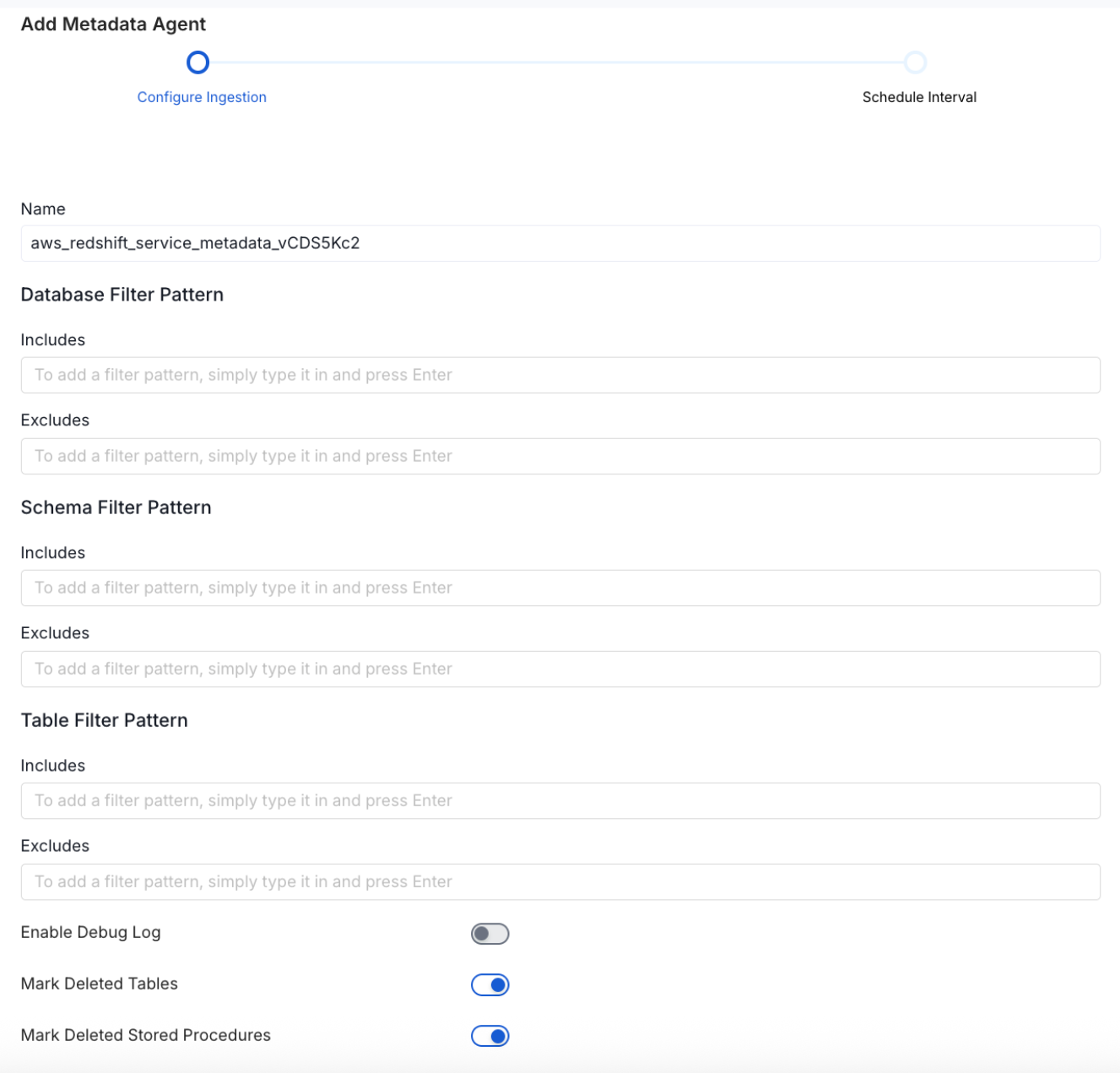
 #### Metadata Ingestion Options
If the owner's name is openmetadata, you need to enter `openmetadata@domain.com` in the name section of add team/user form, click [here](/connectors/database/dbt/ingest-dbt-owner#following-steps-shows-adding-a-user-to-openmetadata) for more info.
* **Name**: This field refers to the name of ingestion pipeline, you can customize the name or use the generated name.
* **Database Filter Pattern (Optional)**: Use to database filter patterns to control whether or not to include database as part of metadata ingestion.
* **Include**: Explicitly include databases by adding a list of comma-separated regular expressions to the Include field. OpenMetadata will include all databases with names matching one or more of the supplied regular expressions. All other databases will be excluded.
* **Exclude**: Explicitly exclude databases by adding a list of comma-separated regular expressions to the Exclude field. OpenMetadata will exclude all databases with names matching one or more of the supplied regular expressions. All other databases will be included.
* **Schema Filter Pattern (Optional)**: Use to schema filter patterns to control whether to include schemas as part of metadata ingestion.
* **Include**: Explicitly include schemas by adding a list of comma-separated regular expressions to the Include field. OpenMetadata will include all schemas with names matching one or more of the supplied regular expressions. All other schemas will be excluded.
* **Exclude**: Explicitly exclude schemas by adding a list of comma-separated regular expressions to the Exclude field. OpenMetadata will exclude all schemas with names matching one or more of the supplied regular expressions. All other schemas will be included.
* **Table Filter Pattern (Optional)**: Use to table filter patterns to control whether to include tables as part of metadata ingestion.
* **Include**: Explicitly include tables by adding a list of comma-separated regular expressions to the Include field. OpenMetadata will include all tables with names matching one or more of the supplied regular expressions. All other tables will be excluded.
* **Exclude**: Explicitly exclude tables by adding a list of comma-separated regular expressions to the Exclude field. OpenMetadata will exclude all tables with names matching one or more of the supplied regular expressions. All other tables will be included.
* **Enable Debug Log (toggle)**: Set the Enable Debug Log toggle to set the default log level to debug.
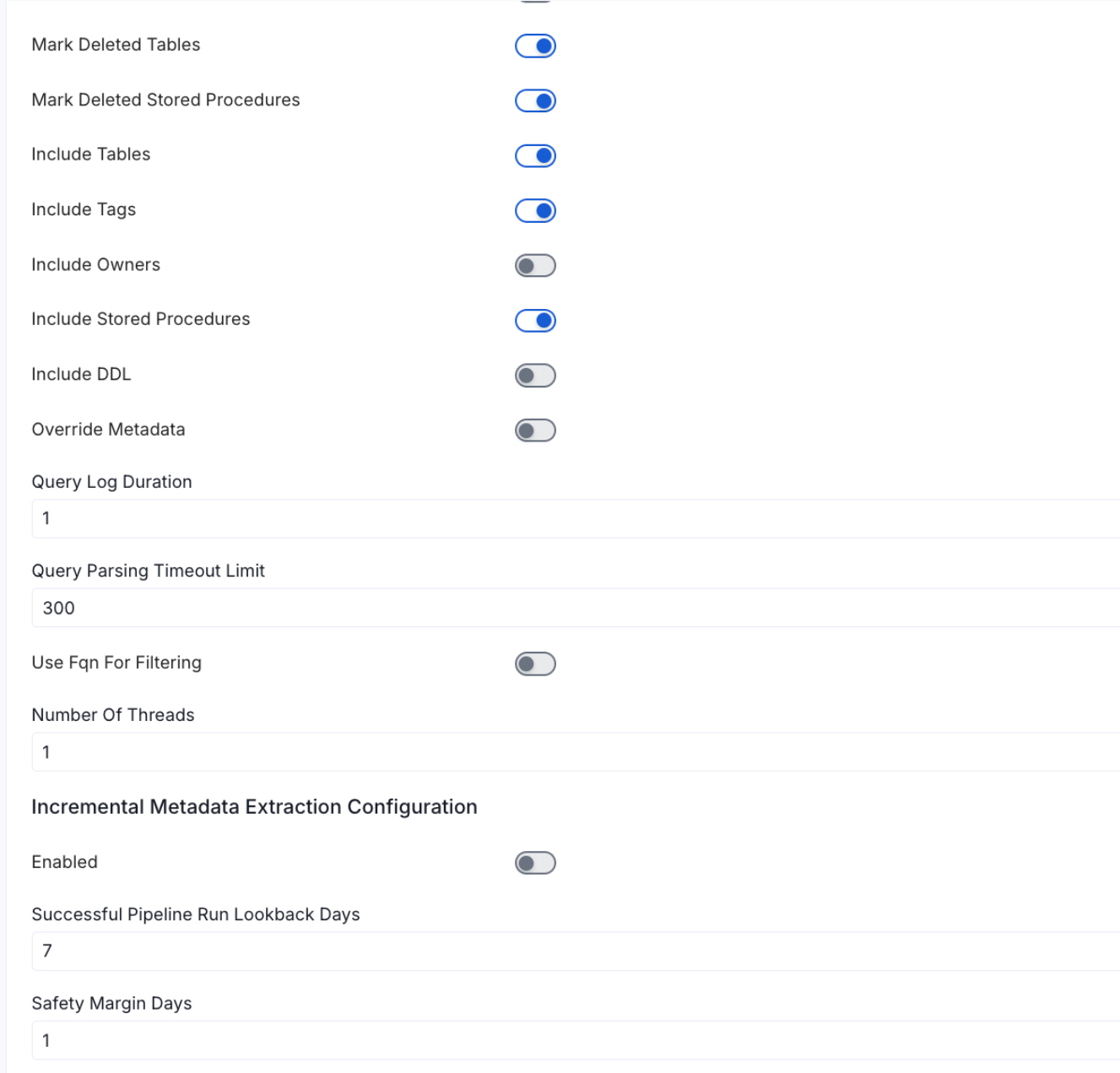
* **Mark Deleted Tables (toggle)**: Set the Mark Deleted Tables toggle to flag tables as soft-deleted if they are not present anymore in the source system.
* **Mark Deleted Tables from Filter Only (toggle)**: Set the Mark Deleted Tables from Filter Only toggle to flag tables as soft-deleted if they are not present anymore within the filtered schema or database only. This flag is useful when you have more than one ingestion pipelines. For example if you have a schema
* **includeTables (toggle)**: Optional configuration to turn off fetching metadata for tables.
* **includeViews (toggle)**: Set the Include views toggle to control whether to include views as part of metadata ingestion.
* **includeTags (toggle)**: Set the 'Include Tags' toggle to control whether to include tags as part of metadata ingestion.
* **includeOwners (toggle)**: Set the 'Include Owners' toggle to control whether to include owners to the ingested entity if the owner email matches with a user stored in the OM server as part of metadata ingestion. If the ingested entity already exists and has an owner, the owner will not be overwritten.
* **includeStoredProcedures (toggle)**: Optional configuration to toggle the Stored Procedures ingestion.
* **includeDDL (toggle)**: Optional configuration to toggle the DDL Statements ingestion.
* **queryLogDuration (Optional)**: Configuration to tune how far we want to look back in query logs to process Stored Procedures results.
* **queryParsingTimeoutLimit (Optional)**: Configuration to set the timeout for parsing the query in seconds.
* **useFqnForFiltering (toggle)**: Regex will be applied on fully qualified name (e.g service\_name.db\_name.schema\_name.table\_name) instead of raw name (e.g. table\_name).
* **Incremental (Beta)**: Use Incremental Metadata Extraction after the first execution. This is done by getting the changed tables instead of all of them. **Only Available for BigQuery, Redshift and Snowflake**
* **Enabled**: If `True`, enables Metadata Extraction to be Incremental.
* **lookback Days**: Number of days to search back for a successful pipeline run. The timestamp of the last found successful pipeline run will be used as a base to search for updated entities.
* **Safety Margin Days**: Number of days to add to the last successful pipeline run timestamp to search for updated entities.
* **Threads (Beta)**: Use a Multithread approach for Metadata Extraction. You can define here the number of threads you would like to run concurrently.
Note that the right-hand side panel in the OpenMetadata UI will also share useful documentation when configuring the ingestion.
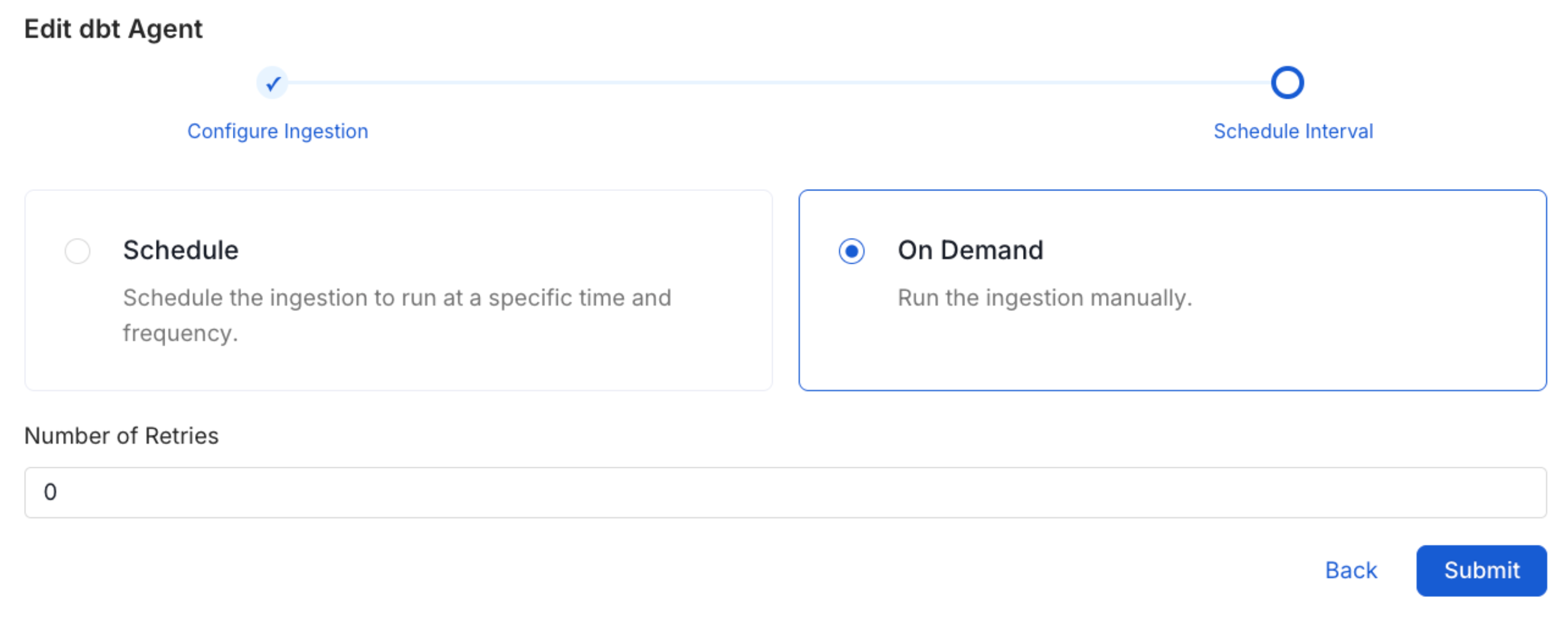
Scheduling can be set up at an hourly, daily, weekly, or manual cadence. The
timezone is in UTC. Select a Start Date to schedule for ingestion. It is
optional to add an End Date.
Review your configuration settings. If they match what you intended,
click Deploy to create the service and schedule metadata ingestion.
If something doesn't look right, click the Back button to return to the
appropriate step and change the settings as needed.
After configuring the workflow, you can click on Deploy to create the
pipeline.
#### Metadata Ingestion Options
If the owner's name is openmetadata, you need to enter `openmetadata@domain.com` in the name section of add team/user form, click [here](/connectors/database/dbt/ingest-dbt-owner#following-steps-shows-adding-a-user-to-openmetadata) for more info.
* **Name**: This field refers to the name of ingestion pipeline, you can customize the name or use the generated name.
* **Database Filter Pattern (Optional)**: Use to database filter patterns to control whether or not to include database as part of metadata ingestion.
* **Include**: Explicitly include databases by adding a list of comma-separated regular expressions to the Include field. OpenMetadata will include all databases with names matching one or more of the supplied regular expressions. All other databases will be excluded.
* **Exclude**: Explicitly exclude databases by adding a list of comma-separated regular expressions to the Exclude field. OpenMetadata will exclude all databases with names matching one or more of the supplied regular expressions. All other databases will be included.
* **Schema Filter Pattern (Optional)**: Use to schema filter patterns to control whether to include schemas as part of metadata ingestion.
* **Include**: Explicitly include schemas by adding a list of comma-separated regular expressions to the Include field. OpenMetadata will include all schemas with names matching one or more of the supplied regular expressions. All other schemas will be excluded.
* **Exclude**: Explicitly exclude schemas by adding a list of comma-separated regular expressions to the Exclude field. OpenMetadata will exclude all schemas with names matching one or more of the supplied regular expressions. All other schemas will be included.
* **Table Filter Pattern (Optional)**: Use to table filter patterns to control whether to include tables as part of metadata ingestion.
* **Include**: Explicitly include tables by adding a list of comma-separated regular expressions to the Include field. OpenMetadata will include all tables with names matching one or more of the supplied regular expressions. All other tables will be excluded.
* **Exclude**: Explicitly exclude tables by adding a list of comma-separated regular expressions to the Exclude field. OpenMetadata will exclude all tables with names matching one or more of the supplied regular expressions. All other tables will be included.
* **Enable Debug Log (toggle)**: Set the Enable Debug Log toggle to set the default log level to debug.
* **Mark Deleted Tables (toggle)**: Set the Mark Deleted Tables toggle to flag tables as soft-deleted if they are not present anymore in the source system.
* **Mark Deleted Tables from Filter Only (toggle)**: Set the Mark Deleted Tables from Filter Only toggle to flag tables as soft-deleted if they are not present anymore within the filtered schema or database only. This flag is useful when you have more than one ingestion pipelines. For example if you have a schema
* **includeTables (toggle)**: Optional configuration to turn off fetching metadata for tables.
* **includeViews (toggle)**: Set the Include views toggle to control whether to include views as part of metadata ingestion.
* **includeTags (toggle)**: Set the 'Include Tags' toggle to control whether to include tags as part of metadata ingestion.
* **includeOwners (toggle)**: Set the 'Include Owners' toggle to control whether to include owners to the ingested entity if the owner email matches with a user stored in the OM server as part of metadata ingestion. If the ingested entity already exists and has an owner, the owner will not be overwritten.
* **includeStoredProcedures (toggle)**: Optional configuration to toggle the Stored Procedures ingestion.
* **includeDDL (toggle)**: Optional configuration to toggle the DDL Statements ingestion.
* **queryLogDuration (Optional)**: Configuration to tune how far we want to look back in query logs to process Stored Procedures results.
* **queryParsingTimeoutLimit (Optional)**: Configuration to set the timeout for parsing the query in seconds.
* **useFqnForFiltering (toggle)**: Regex will be applied on fully qualified name (e.g service\_name.db\_name.schema\_name.table\_name) instead of raw name (e.g. table\_name).
* **Incremental (Beta)**: Use Incremental Metadata Extraction after the first execution. This is done by getting the changed tables instead of all of them. **Only Available for BigQuery, Redshift and Snowflake**
* **Enabled**: If `True`, enables Metadata Extraction to be Incremental.
* **lookback Days**: Number of days to search back for a successful pipeline run. The timestamp of the last found successful pipeline run will be used as a base to search for updated entities.
* **Safety Margin Days**: Number of days to add to the last successful pipeline run timestamp to search for updated entities.
* **Threads (Beta)**: Use a Multithread approach for Metadata Extraction. You can define here the number of threads you would like to run concurrently.
Note that the right-hand side panel in the OpenMetadata UI will also share useful documentation when configuring the ingestion.
Scheduling can be set up at an hourly, daily, weekly, or manual cadence. The
timezone is in UTC. Select a Start Date to schedule for ingestion. It is
optional to add an End Date.
Review your configuration settings. If they match what you intended,
click Deploy to create the service and schedule metadata ingestion.
If something doesn't look right, click the Back button to return to the
appropriate step and change the settings as needed.
After configuring the workflow, you can click on Deploy to create the
pipeline.
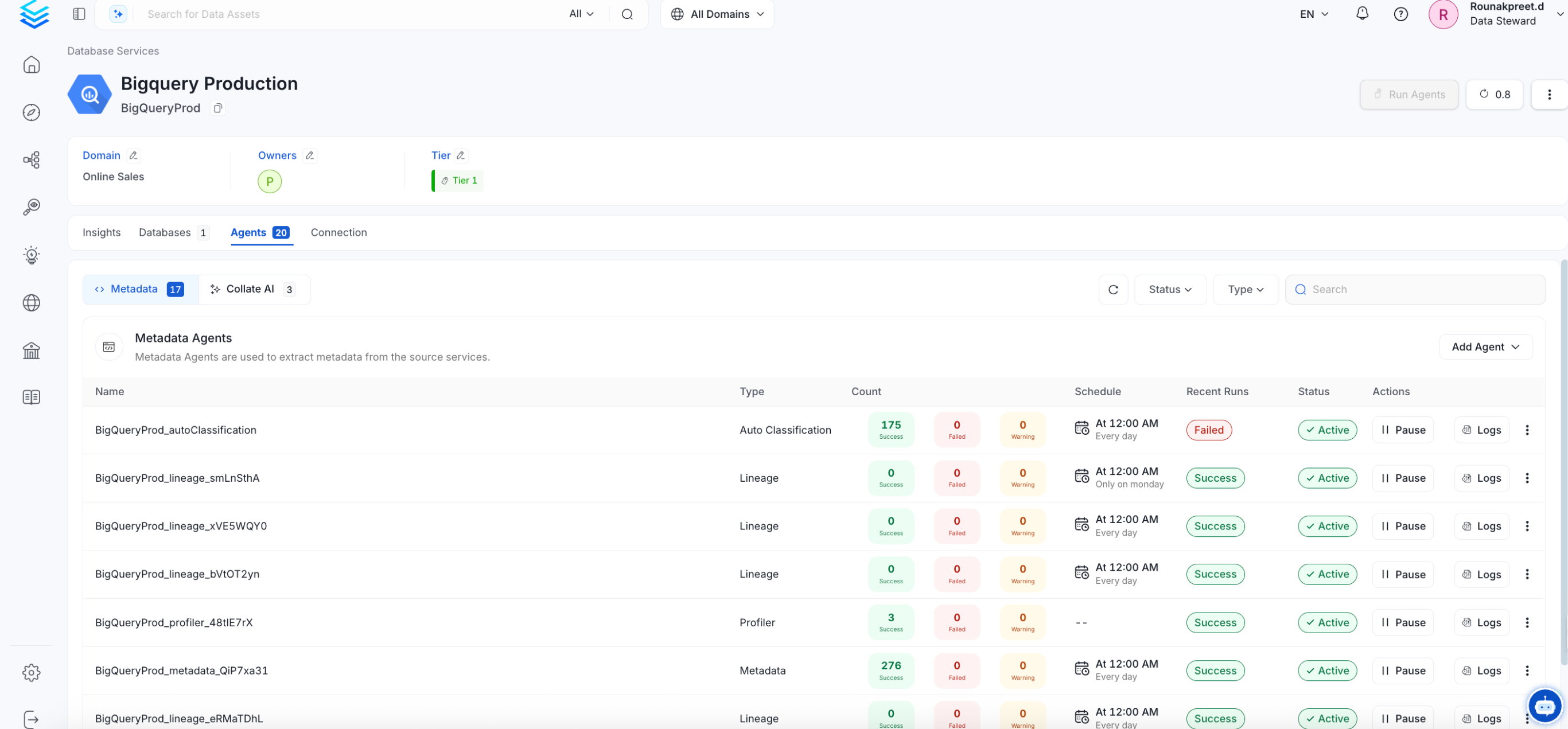
 Once the workflow has been successfully deployed, you can view the
Ingestion Pipeline running from the Service Page.
Once the workflow has been successfully deployed, you can view the
Ingestion Pipeline running from the Service Page.
 If AutoPilot is enabled, workflows like usage tracking, data lineage, and similar tasks will be handled automatically. Users don’t need to set up or manage them - AutoPilot takes care of everything in the system.
## Related
Learn more about how to configure the Usage Workflow to ingest Query information from the UI.
Learn more about how to configure the Lineage from the UI.
Learn more about how to configure the Data Profiler from the UI.
Learn more about how to configure the Data Quality tests from the UI.
Learn more about how to ingest dbt models' definitions and their lineage.
If AutoPilot is enabled, workflows like usage tracking, data lineage, and similar tasks will be handled automatically. Users don’t need to set up or manage them - AutoPilot takes care of everything in the system.
## Related
Learn more about how to configure the Usage Workflow to ingest Query information from the UI.
Learn more about how to configure the Lineage from the UI.
Learn more about how to configure the Data Profiler from the UI.
Learn more about how to configure the Data Quality tests from the UI.
Learn more about how to ingest dbt models' definitions and their lineage.