> ## Documentation Index
> Fetch the complete documentation index at: https://docs.open-metadata.org/llms.txt
> Use this file to discover all available pages before exploring further.
# Metrics for OpenMetadata
# Metrics in OpenMetadata
The **Metrics** entity in OpenMetadata allows users to define, track, and manage key business and operational metrics. Metrics help organizations maintain consistency, traceability, and accuracy in data-driven decision-making.
## Overview of Metrics
Metrics represent calculated values based on data assets and are categorized under the **Governance** section in OpenMetadata. Each metric can be linked to glossary terms, data assets, and other metrics, providing comprehensive visibility into data quality and usage.
## Key Properties of a Metric
| **Property** | **Description** | **Example Value** |
| ----------------------- | --------------------------------------------------------------------------- | ------------------------------ |
| **Name** | Unique identifier for the metric, following camelCase naming conventions. | `customerRetentionRate` |
| **Display Name** | Human-readable name for the metric. | `Customer Retention Rate` |
| **Description** | Detailed explanation of what the metric represents. | `Percentage of retained users` |
| **Expression** | Formula or SQL query used to calculate the metric. | `COUNT(returning_customers)` |
| **Granularity** | Time scale for the metric, such as daily, weekly, or monthly. | `Daily` |
| **Metric Type** | Type of calculation applied to the metric (e.g., count, average, ratio). | `Percentage` |
| **Unit of Measurement** | Unit for interpreting metric values, such as count, dollars, or percentage. | `Percentage` |
| **SQL Query** | Optional SQL query defining the metric. | `SELECT COUNT(*) FROM sales` |
| **Owner** | Individual or team responsible for maintaining the metric. | `Data Governance Team` |
## Metric Lineage and Dependencies
OpenMetadata allows users to trace the source and dependencies of metrics using lineage. This ensures end-to-end traceability from raw data to metric reporting. A typical lineage might look like:
```commandline theme={null}
Database Table → Metric → Pipeline → Dashboard
```
Users can view associated tables, pipelines, and dashboards to understand how metrics are generated and utilized.
## Creating Metrics Using the UI
To create a new metric in OpenMetadata using the user interface, follow these steps:
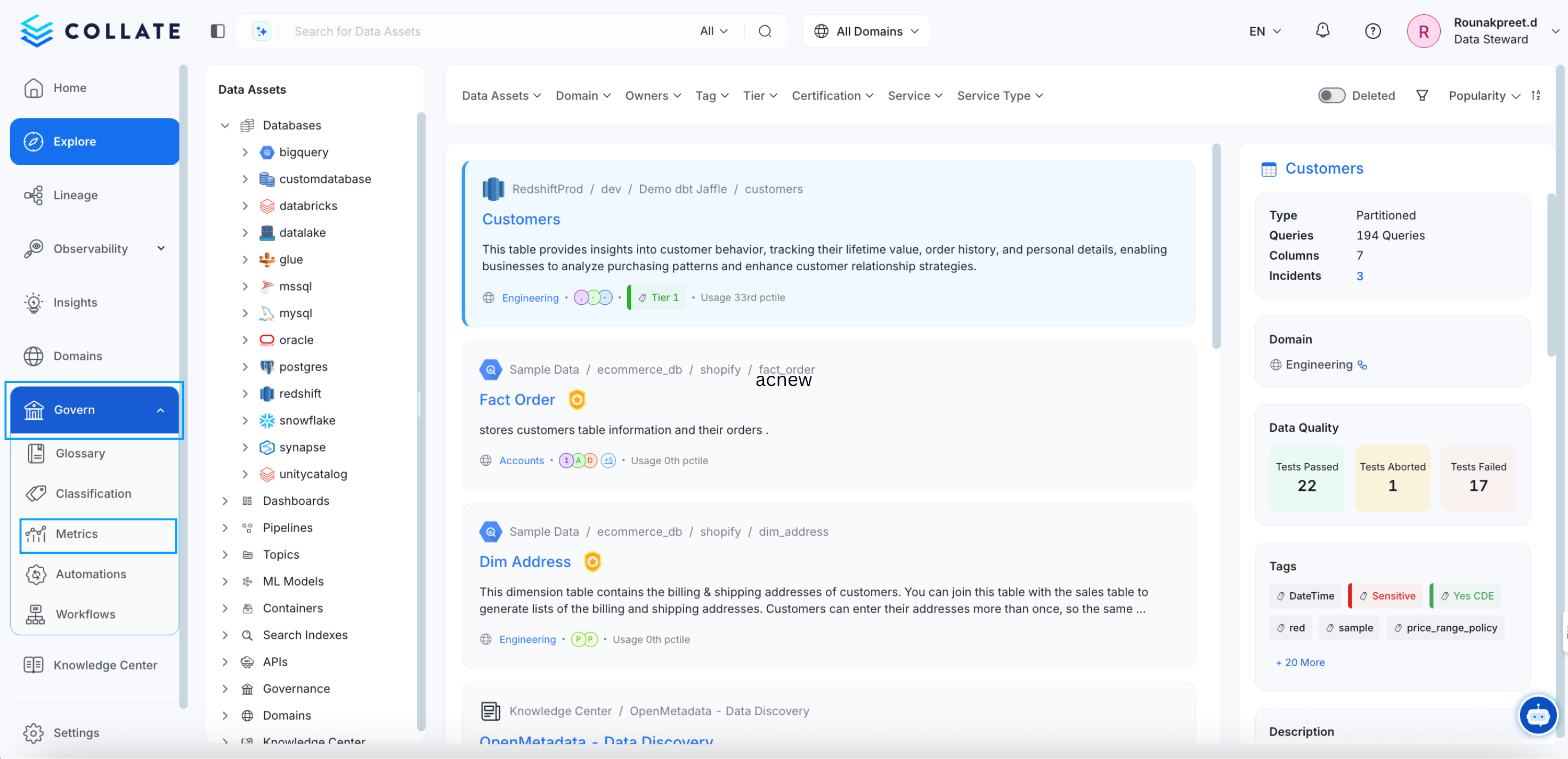
### 1. Navigate to the Metrics Section
* Go to **Govern > Metrics** in the OpenMetadata UI.
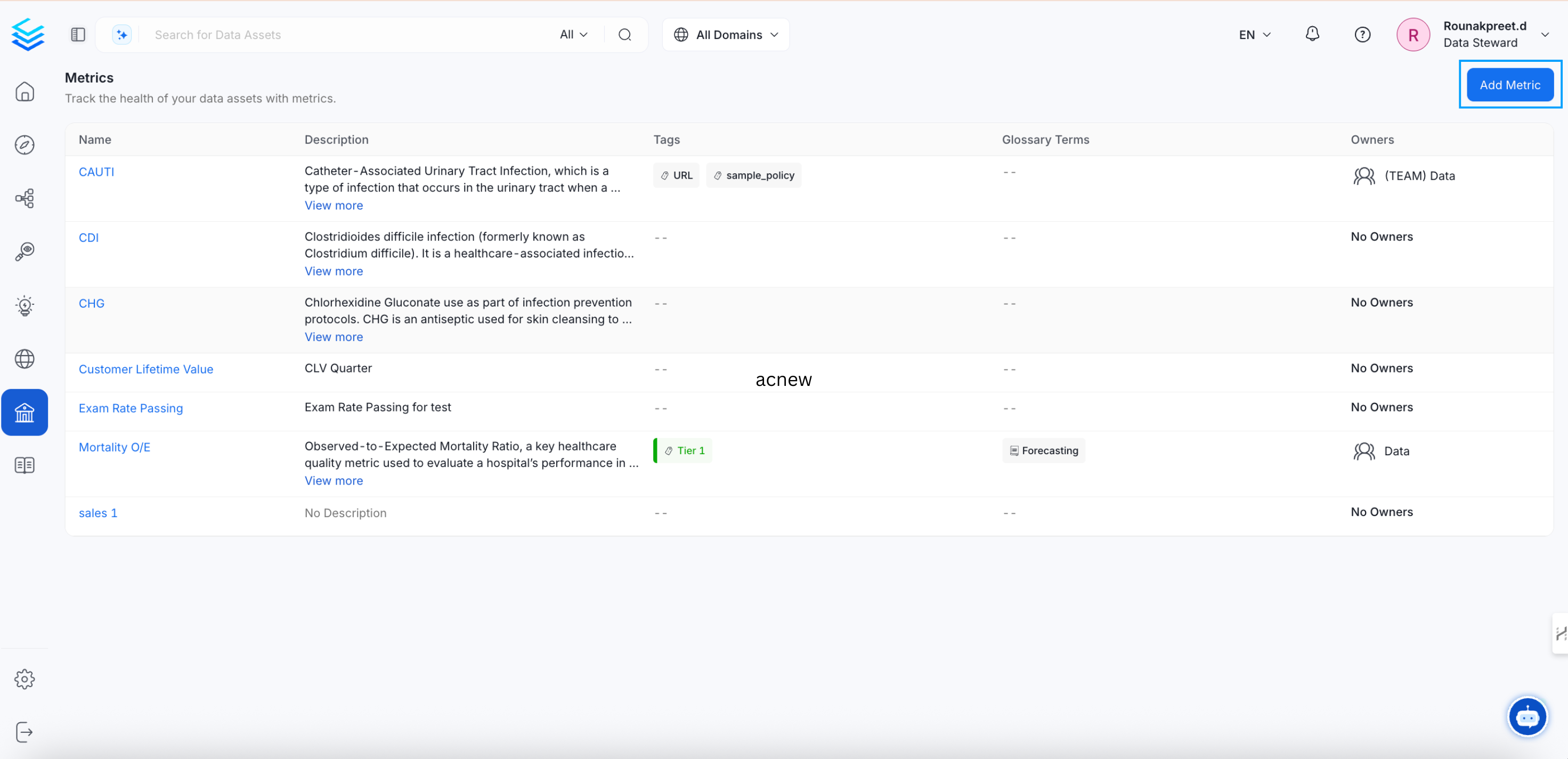
 ### 2. Add a New Metric
* Click on **Add Metric** to initiate the metric creation process.
### 2. Add a New Metric
* Click on **Add Metric** to initiate the metric creation process.
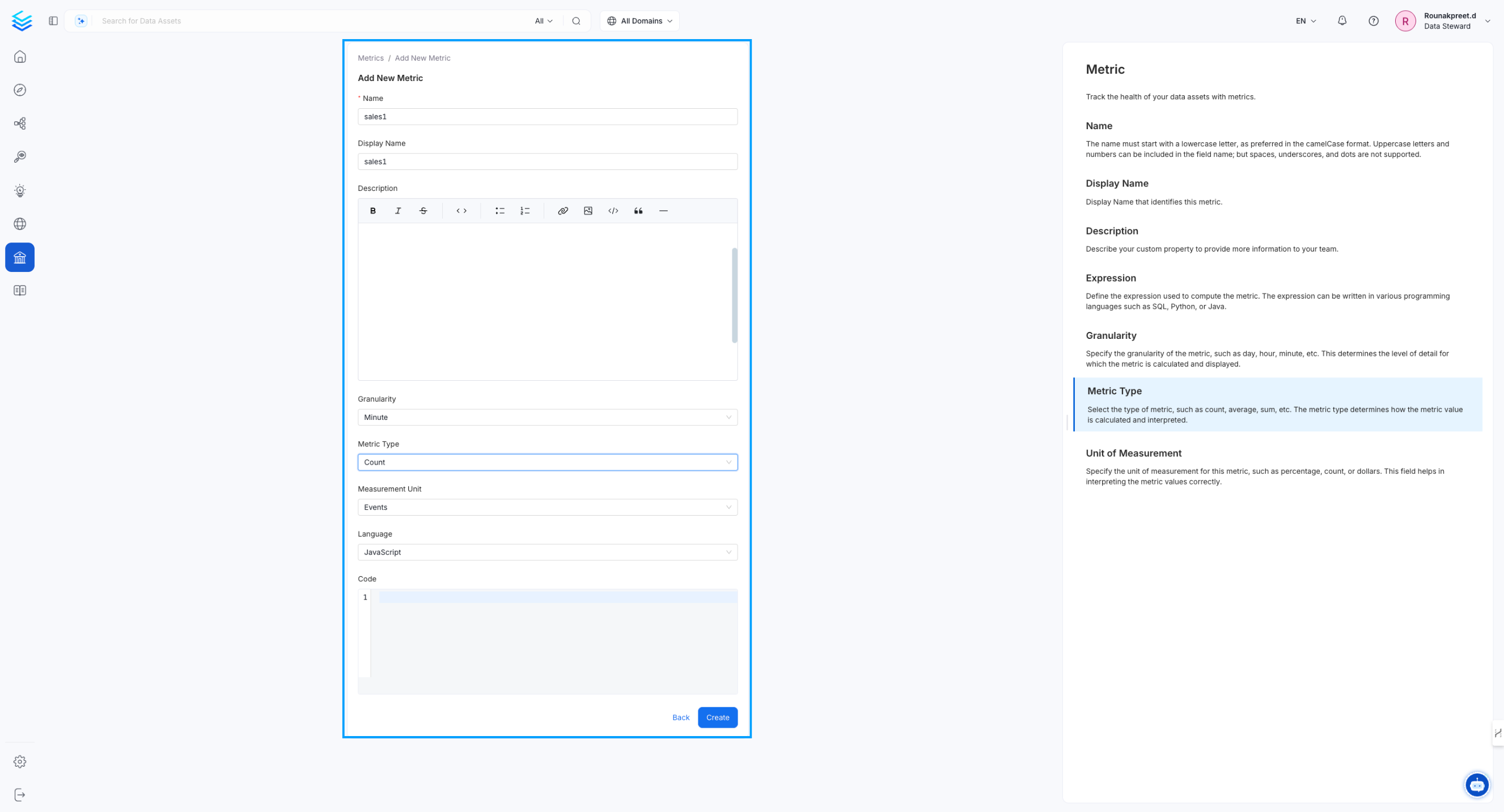
 ### 3. Enter Metric Details
Provide the required information, including:
* **Metric Name**
* **Description**
* **Granularity** (time scale of the metric)
* **Metric Type** (e.g., count, average, ratio)
* **Computation Code** (SQL, Python, or Java) if applicable
### 4. Create the Metric
* After entering the details, click **Create** to finalize the metric.
### 3. Enter Metric Details
Provide the required information, including:
* **Metric Name**
* **Description**
* **Granularity** (time scale of the metric)
* **Metric Type** (e.g., count, average, ratio)
* **Computation Code** (SQL, Python, or Java) if applicable
### 4. Create the Metric
* After entering the details, click **Create** to finalize the metric.
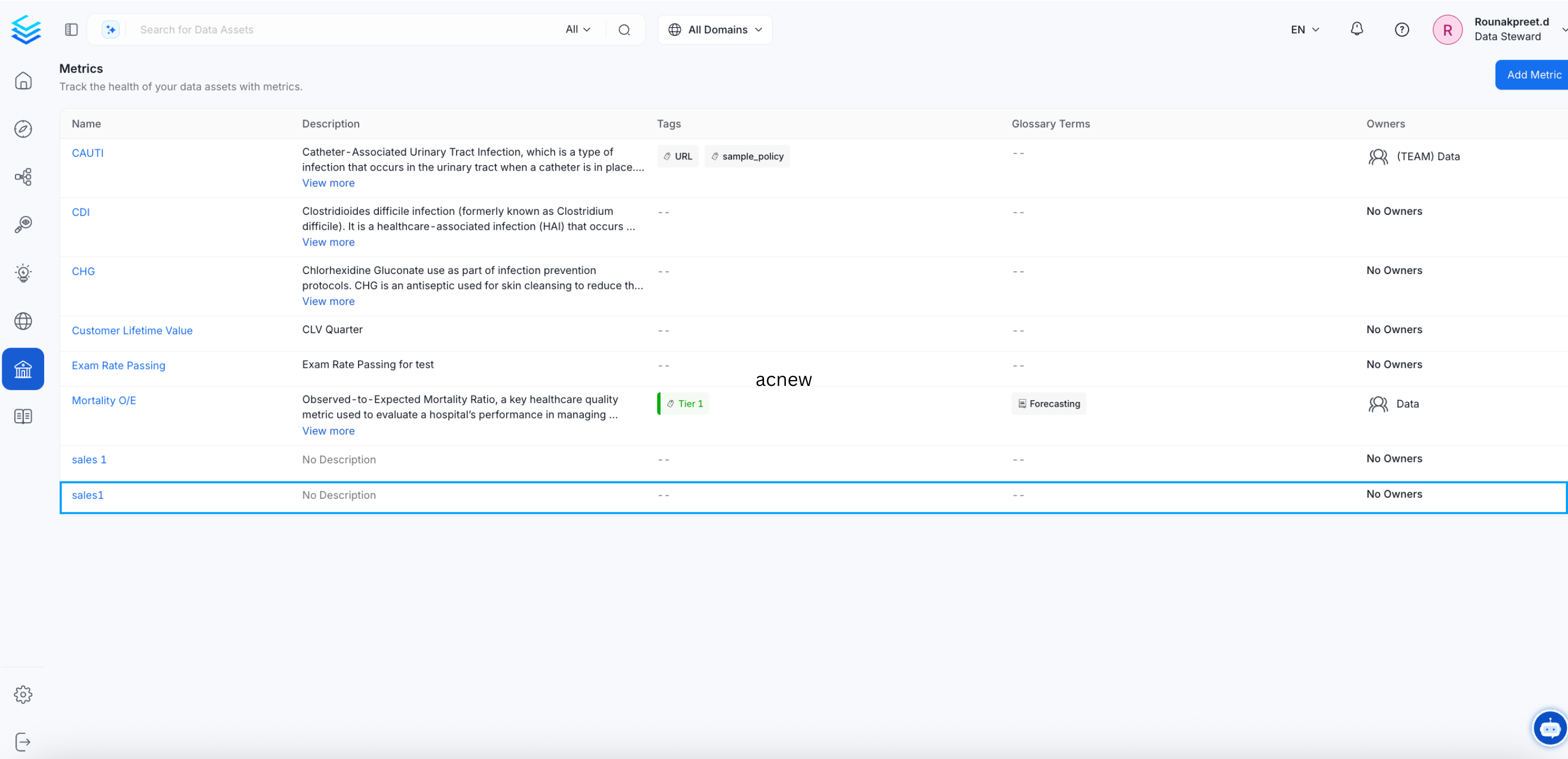
 ### 5. View the Created Metric
* The newly created metric will now be available in the **Metrics** page for reference and further use.
### 5. View the Created Metric
* The newly created metric will now be available in the **Metrics** page for reference and further use.
 ## Example JSON Schema for Metric
```json theme={null}
{
"id": "123e4567-e89b-12d3-a456-426614174000",
"name": "customerRetentionRate",
"displayName": "Customer Retention Rate",
"description": "Percentage of customers retained over a given period.",
"formula": "COUNT(returning_customers) / COUNT(total_customers) * 100",
"sql": "SELECT COUNT(*) FROM customer_activity WHERE status='active'",
"granularity": "Monthly",
"metricType": "Percentage",
"unit": "Percentage",
"owner": "Data Governance Team",
"tags": ["Customer", "KPI", "Retention"]
}
```
## Managing Metrics in OpenMetadata
* **Versioning**: Each update to a metric creates a new version, maintaining historical changes.
* **Linking**: Metrics can be linked to glossary terms, tables, dashboards, and pipelines for enriched context.
* **Monitoring**: Metrics can be monitored for value changes, enabling trend analysis over time
## Best Practices for Metric Management
* **Consistent Naming**: Use camelCase for metric names to ensure consistency across systems.
* **Clear Definitions**: Provide comprehensive descriptions and units for accurate interpretation.
* **Lineage Tracking**: Always associate metrics with source tables and pipelines for traceability.
* **Ownership**: Assign metric owners for accountability and maintenance.
## Example JSON Schema for Metric
```json theme={null}
{
"id": "123e4567-e89b-12d3-a456-426614174000",
"name": "customerRetentionRate",
"displayName": "Customer Retention Rate",
"description": "Percentage of customers retained over a given period.",
"formula": "COUNT(returning_customers) / COUNT(total_customers) * 100",
"sql": "SELECT COUNT(*) FROM customer_activity WHERE status='active'",
"granularity": "Monthly",
"metricType": "Percentage",
"unit": "Percentage",
"owner": "Data Governance Team",
"tags": ["Customer", "KPI", "Retention"]
}
```
## Managing Metrics in OpenMetadata
* **Versioning**: Each update to a metric creates a new version, maintaining historical changes.
* **Linking**: Metrics can be linked to glossary terms, tables, dashboards, and pipelines for enriched context.
* **Monitoring**: Metrics can be monitored for value changes, enabling trend analysis over time
## Best Practices for Metric Management
* **Consistent Naming**: Use camelCase for metric names to ensure consistency across systems.
* **Clear Definitions**: Provide comprehensive descriptions and units for accurate interpretation.
* **Lineage Tracking**: Always associate metrics with source tables and pipelines for traceability.
* **Ownership**: Assign metric owners for accountability and maintenance.