> ## Documentation Index
> Fetch the complete documentation index at: https://docs.open-metadata.org/llms.txt
> Use this file to discover all available pages before exploring further.
# Articles
> Long-form pages your team writes and maintains.
# Articles
Articles are Context Center's internal knowledge base: long-form pages your team writes, organizes, and maintains for people. Use them for durable, structured knowledge that's worth maintaining as a page, such as data governance policies, classification standards, incident playbooks, or internal API documentation.
## Create an Article
1. From the left sidebar, navigate to **Context Center** > **Articles**.
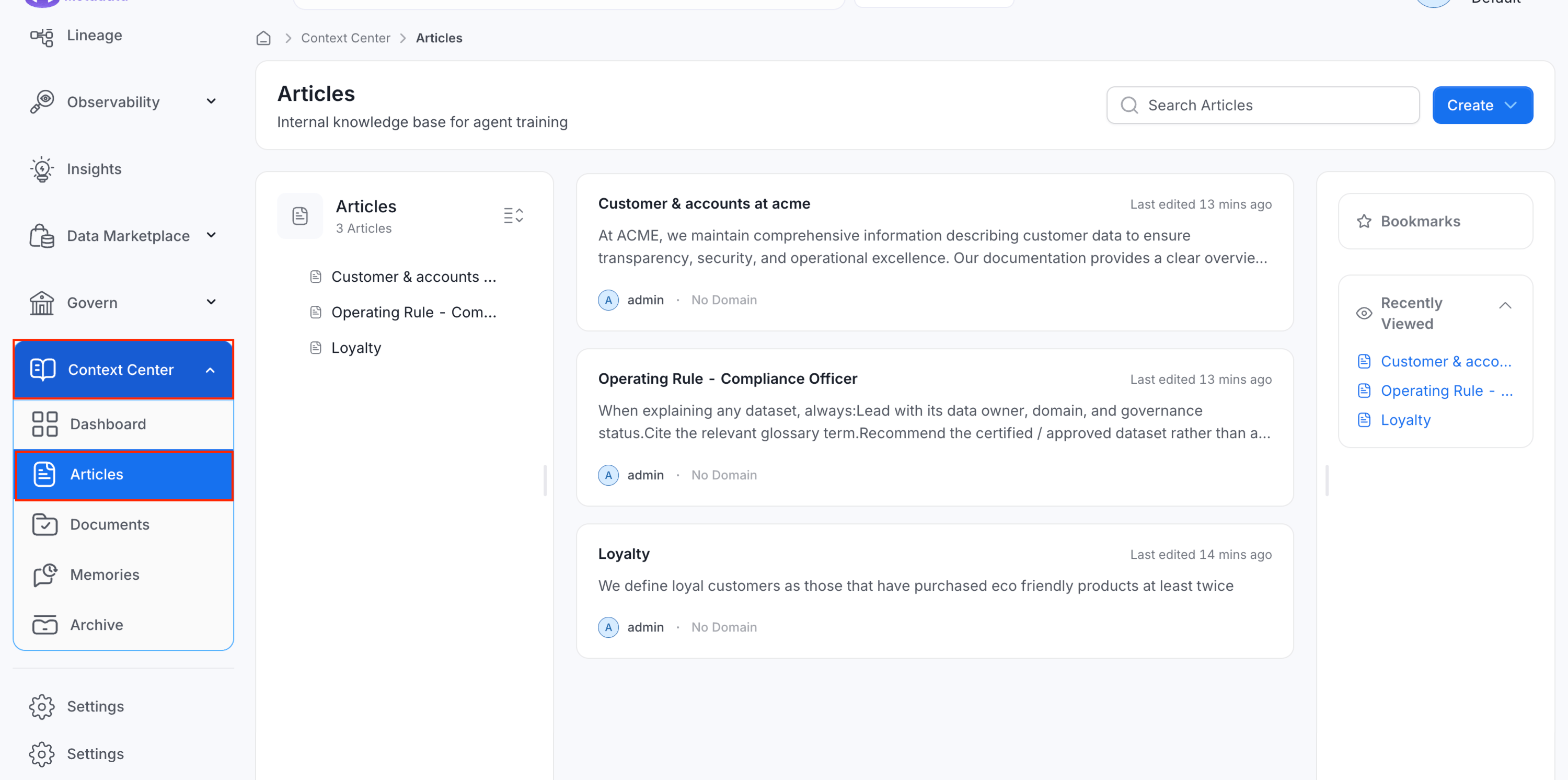 2. Click **Create** and choose:
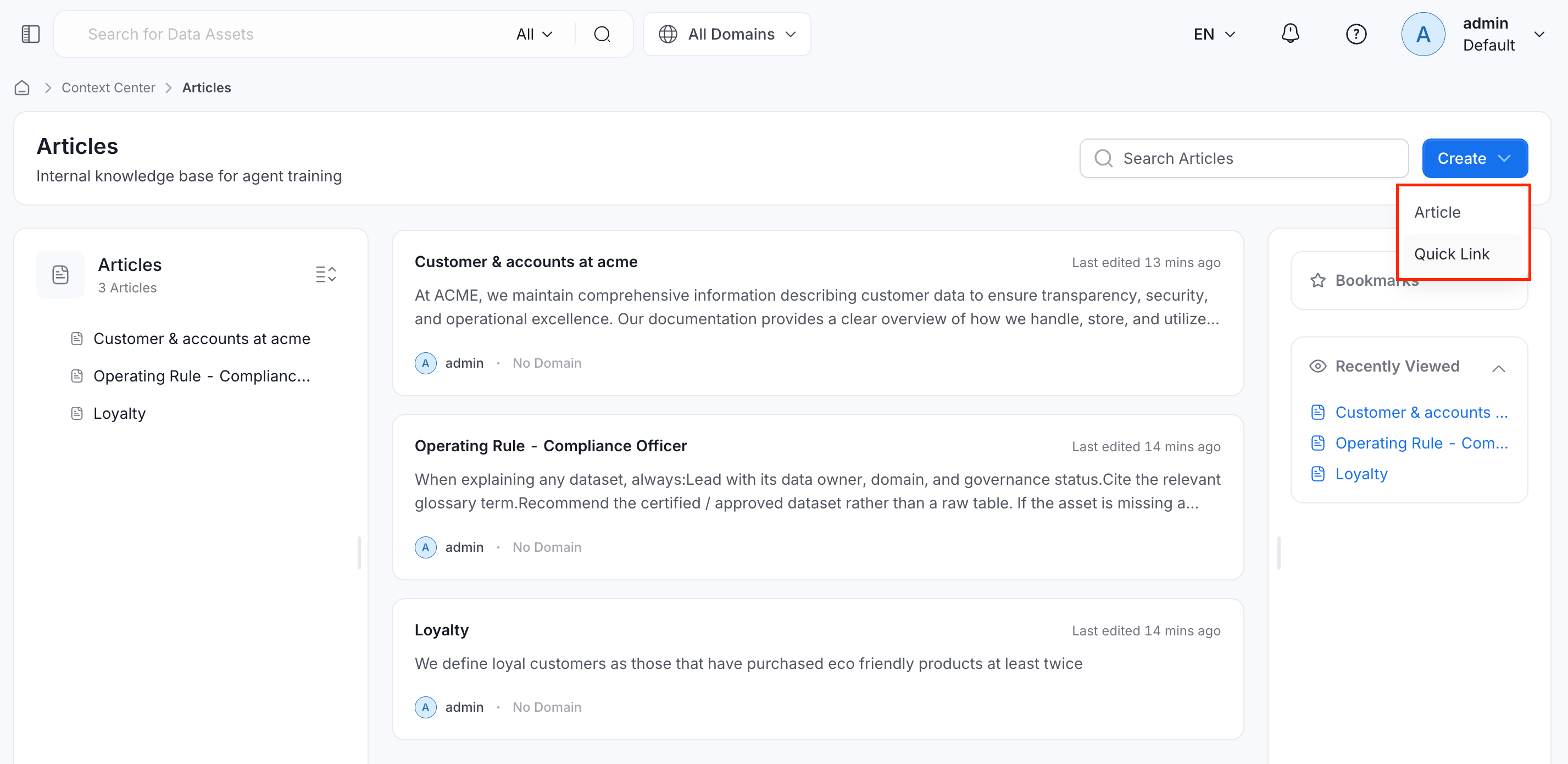
* **Article**: Opens a blank page in the rich text editor. Give it a title and start writing. Slash commands, text formatting, and nested lists are all supported.
* **Quick Link**: Bookmarks an external URL as an article instead of writing new content. Add a title, description, the target URL, and tags.
2. Click **Create** and choose:
* **Article**: Opens a blank page in the rich text editor. Give it a title and start writing. Slash commands, text formatting, and nested lists are all supported.
* **Quick Link**: Bookmarks an external URL as an article instead of writing new content. Add a title, description, the target URL, and tags.
 Articles autosave as you type. There's no separate publish step.
## View and Manage Articles
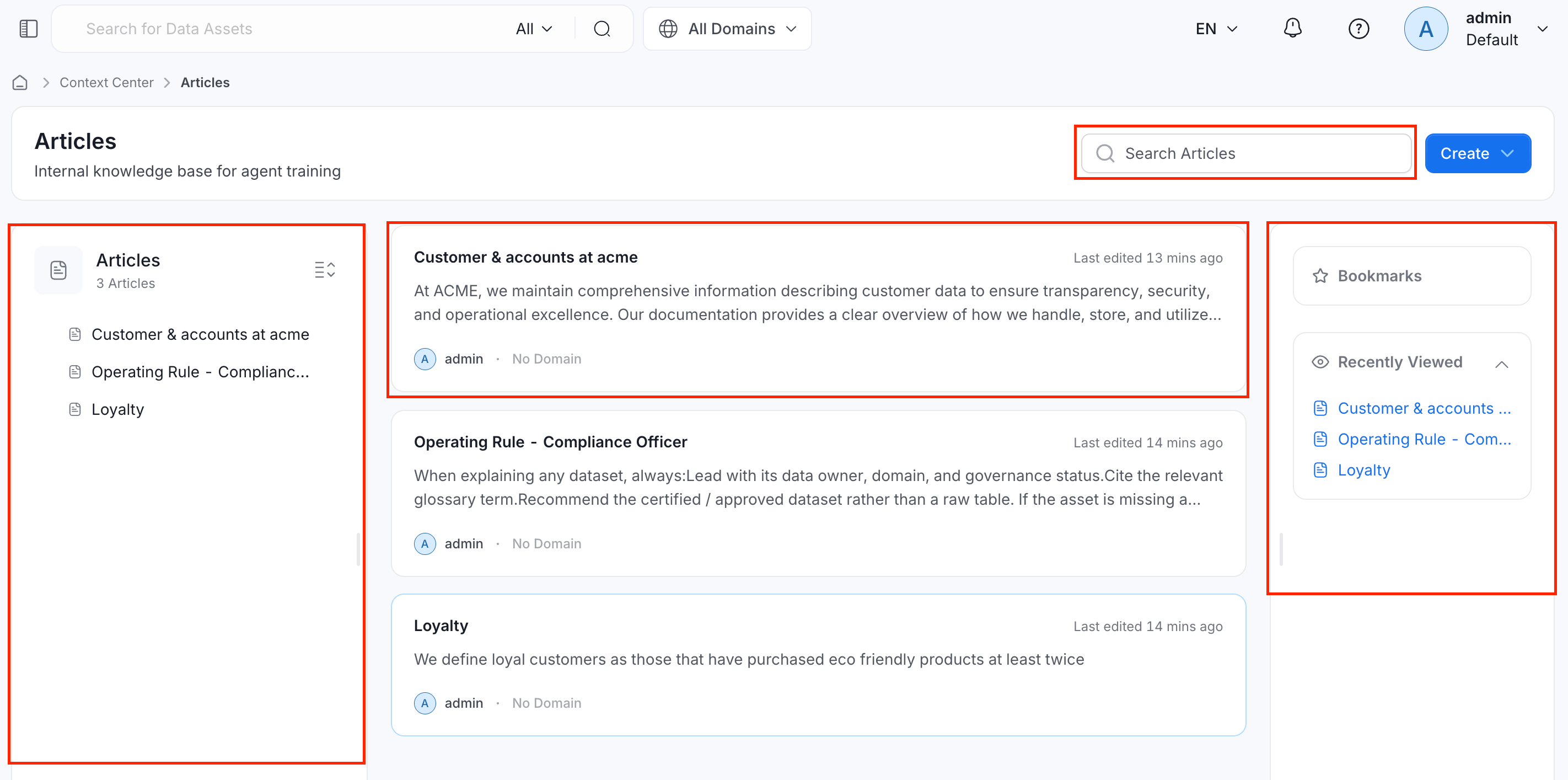
The **Articles** list page helps you find and browse existing articles:
* A search bar to look up articles by title.
* A left-hand hierarchy panel that organizes articles into folders, so related articles, for example everything under a "Compliance" or "Engineering" folder, stay grouped together.
* A card for each article, showing its title, a short description (or "No description" if none is set), when it was last edited, its owner, its domain, and any tags applied to it.
* A right-hand panel with two sections:
* **Bookmarks**: Shows the articles you've bookmarked.
* **Recently Viewed**: The articles you opened most recently, newest first.
Articles autosave as you type. There's no separate publish step.
## View and Manage Articles
The **Articles** list page helps you find and browse existing articles:
* A search bar to look up articles by title.
* A left-hand hierarchy panel that organizes articles into folders, so related articles, for example everything under a "Compliance" or "Engineering" folder, stay grouped together.
* A card for each article, showing its title, a short description (or "No description" if none is set), when it was last edited, its owner, its domain, and any tags applied to it.
* A right-hand panel with two sections:
* **Bookmarks**: Shows the articles you've bookmarked.
* **Recently Viewed**: The articles you opened most recently, newest first.
 Opening an article takes you to its detail page, which includes:
* **Header information**: The article's domain and owner, each shown as a chip you can edit inline by clicking the pencil icon next to it. When editors are assigned, an **Editor** list appears alongside them.
* **Save status and version**: A **Saved** indicator confirms your latest edit was captured automatically, and a version number, for example `0.2`, increases each time the article is updated, so you can track how much it's changed over time.
* **Status badge**: If the article has an open review request, a badge such as **In Review** appears next to its title.
* **Toolbar actions**, next to the Saved indicator:
* **Feedback**: Thumbs up or thumbs down on the article.
* **Conversation**: Open a comment thread on the article.
* **Favorite**: Bookmark the article so it's easy to find again later.
* **Copy link**: Use the copy icon to copy the article URL.
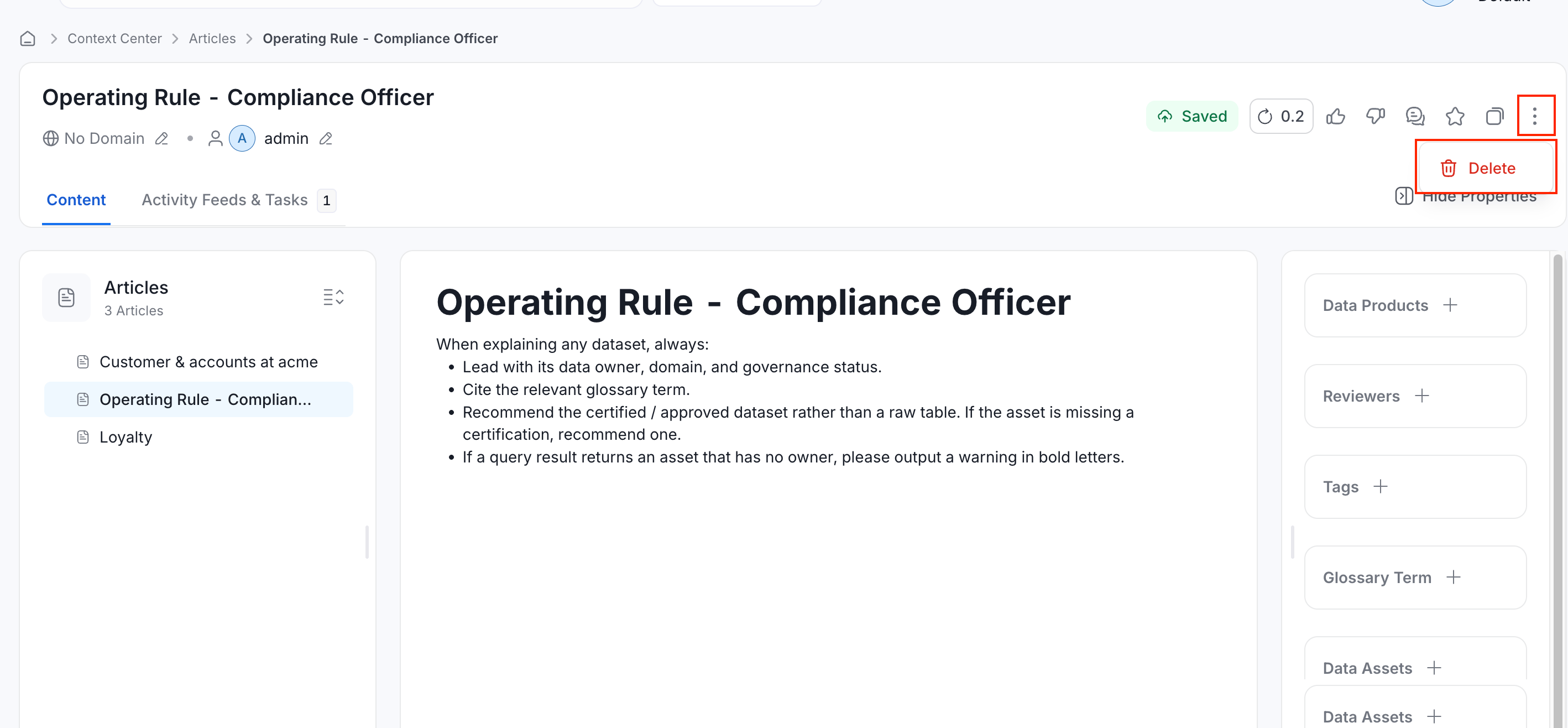
* **Delete**: Open the **⋮** menu and select **Delete** to remove the article.
Opening an article takes you to its detail page, which includes:
* **Header information**: The article's domain and owner, each shown as a chip you can edit inline by clicking the pencil icon next to it. When editors are assigned, an **Editor** list appears alongside them.
* **Save status and version**: A **Saved** indicator confirms your latest edit was captured automatically, and a version number, for example `0.2`, increases each time the article is updated, so you can track how much it's changed over time.
* **Status badge**: If the article has an open review request, a badge such as **In Review** appears next to its title.
* **Toolbar actions**, next to the Saved indicator:
* **Feedback**: Thumbs up or thumbs down on the article.
* **Conversation**: Open a comment thread on the article.
* **Favorite**: Bookmark the article so it's easy to find again later.
* **Copy link**: Use the copy icon to copy the article URL.
* **Delete**: Open the **⋮** menu and select **Delete** to remove the article.
 * **Content** and **Activity Feeds & Tasks** tabs:
* **Content** is the article body itself, where you write and edit using the rich text editor.
* **Activity Feeds & Tasks** tracks everything that's happened on the article, split into two views:
* **All**: A chronological feed of every change, who created or updated the article and when, with a short description of what changed. React to an entry with an emoji, or reply to start a thread on it.
* **Tasks**: Request-driven items on the article, such as an open review request, tracked separately from the general activity feed.
* **Content** and **Activity Feeds & Tasks** tabs:
* **Content** is the article body itself, where you write and edit using the rich text editor.
* **Activity Feeds & Tasks** tracks everything that's happened on the article, split into two views:
* **All**: A chronological feed of every change, who created or updated the article and when, with a short description of what changed. React to an entry with an emoji, or reply to start a thread on it.
* **Tasks**: Request-driven items on the article, such as an open review request, tracked separately from the general activity feed.
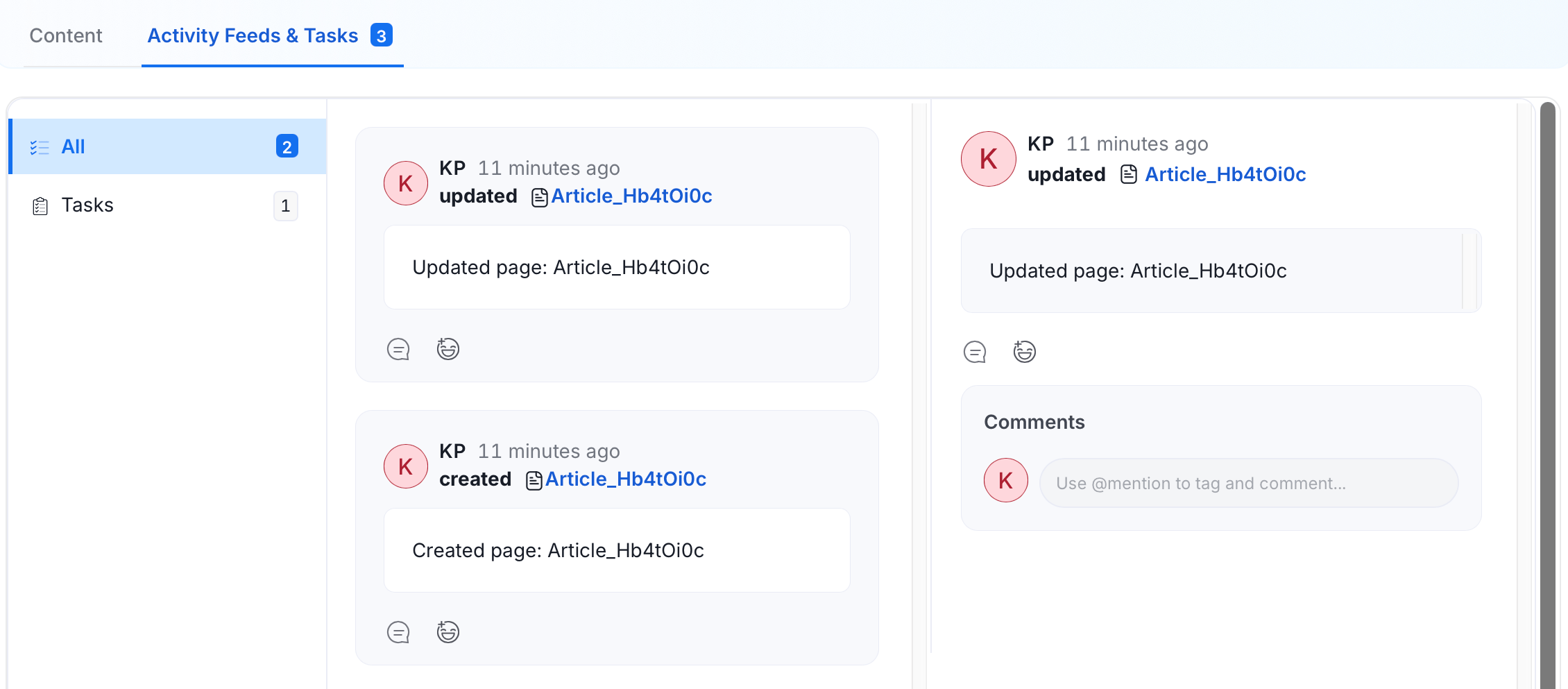 * Selecting an entry opens its details on the right, along with a **Comments** panel where you can add a comment and use `@mention` to tag a teammate.
* **Properties panel**: Attach **Data Products**, **Reviewers**, **Tags**, a **Glossary Term**, related **Data Assets**, or **Attachments** to the article, each with its own `+` button.
Quick Links, unlike written articles, show **Edit** and **Delete** icons directly on their card in the list, since there's no separate detail page to open.
* Selecting an entry opens its details on the right, along with a **Comments** panel where you can add a comment and use `@mention` to tag a teammate.
* **Properties panel**: Attach **Data Products**, **Reviewers**, **Tags**, a **Glossary Term**, related **Data Assets**, or **Attachments** to the article, each with its own `+` button.
Quick Links, unlike written articles, show **Edit** and **Delete** icons directly on their card in the list, since there's no separate detail page to open.