
Use Cases: Roles and Policies
OpenMetadata includes two default configurations out of the box – the Organization Policy and the Data Consumer role – both designed to encourage open data collaboration across your team. Keep the Organization Policy in place. It lets everyone view assets and claim ownership when no owner is assigned, which keeps your catalog healthy and well-maintained. For individual teams, tailor your policies to match what each team actually needs. The use cases below show how to handle the most common access control scenarios – from simple service creation to sensitive personally identifiable information (PII) protection.Use Cases
Use Case 1: Let Teams Create Services and Extract Metadata
Goal: Allow specific users to set up database connections and run ingestion pipelines without needing an admin every time. Create a policy with Database Service, Ingestion Pipeline, and Workflow resources, with all operations set toAllow.
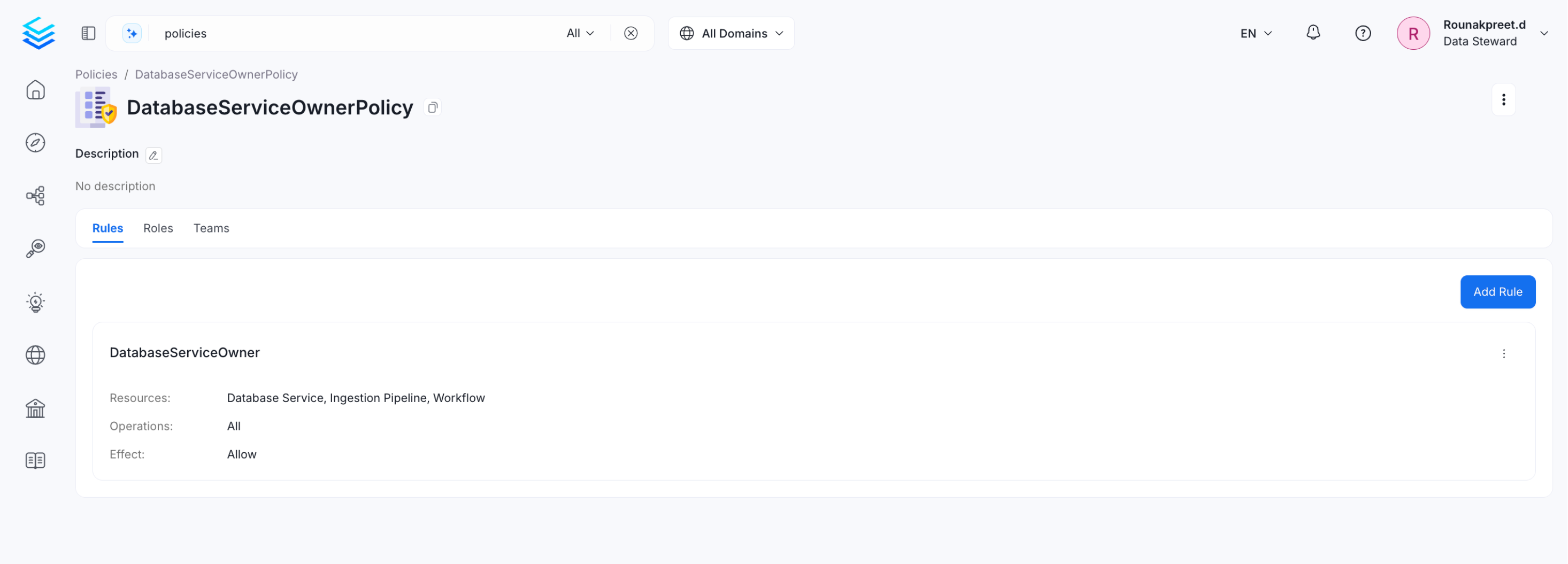
ServiceOwner role and assign this policy to it. Users with this role can create services and extract metadata on their own – no admin involvement needed.
Use Case 2: Set Up a Data Steward Role
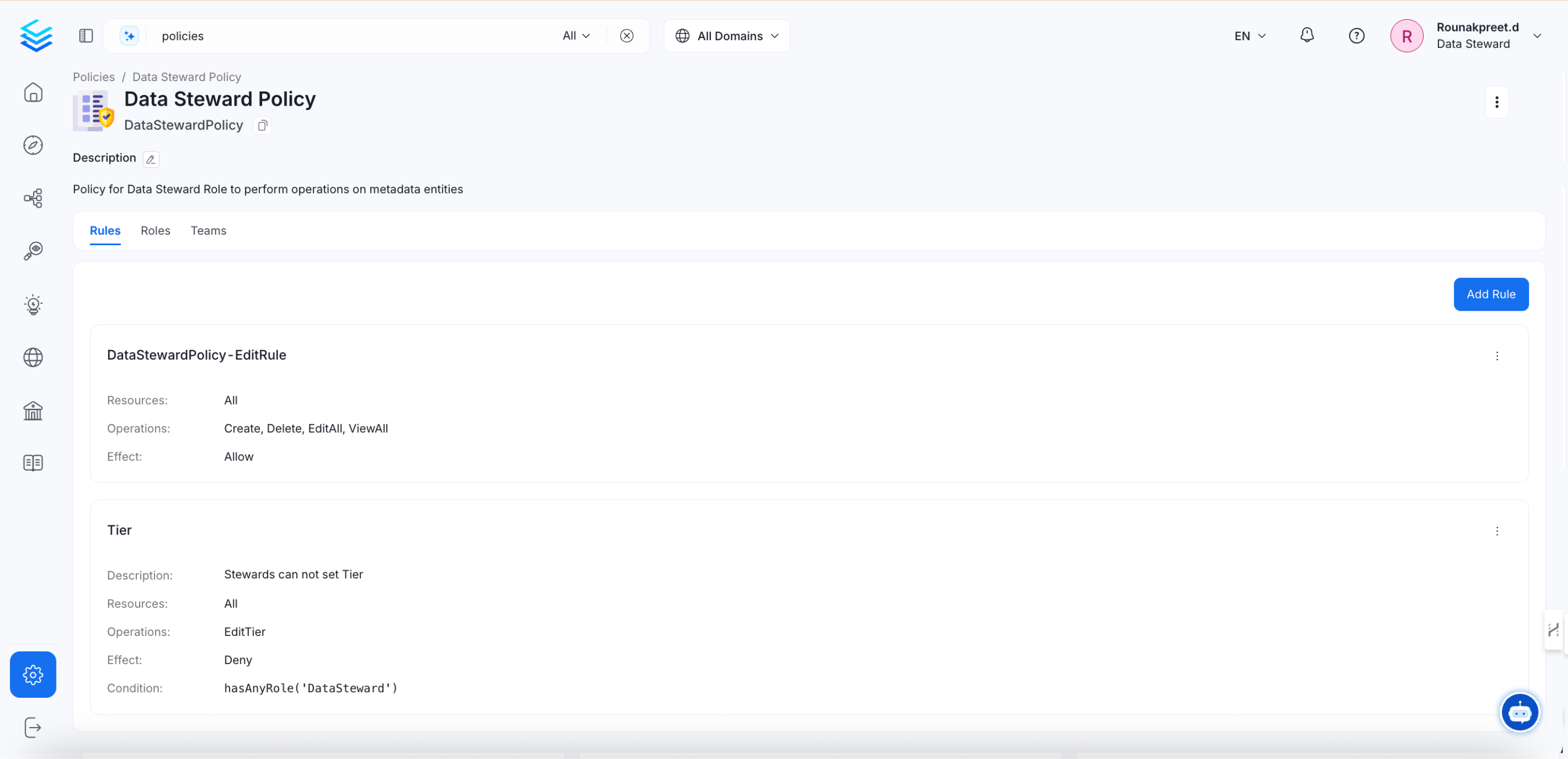
Goal: Give data stewards the access they need to manage governance – creating glossaries, applying tags, and editing metadata across all assets. Build a policy with two rules:- Allow glossary operations – allows all operations on Glossary and Glossary Term resources, so the steward can create and manage business definitions.
- Edit rule – grants
EditDescriptionandEditTagson all entities, so the steward can enrich and label data assets across the catalog.
Use Case 3: Restrict Access to Assets Owned by a Specific Team
Goal: Make sure only the team that owns a data asset can access it – block everyone else. Create a rule that denies all operations when the user isn’t the owner of the asset and their team isn’t the owner either.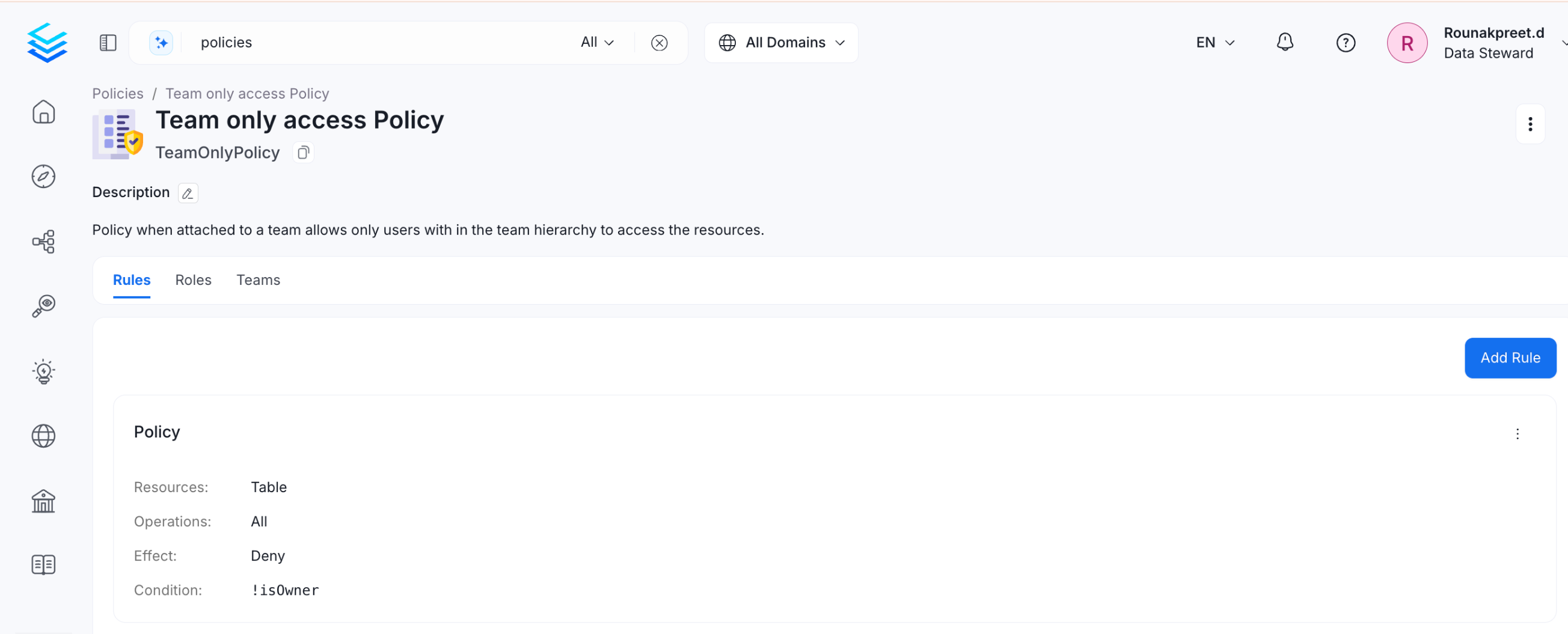
isOwner() and matchTeam() conditions together. If neither condition is true for the user, access is denied.
Use Case 4: Protect PII-Tagged Assets and Allow Only Owners to Access Them
Goal: Lock down any asset tagged withPII.Sensitive so only its owner or owning team can access it.
Create a rule that denies all operations on a Table when it carries the PII.Sensitive tag and the user isn’t the owner – and their team isn’t the owner either.
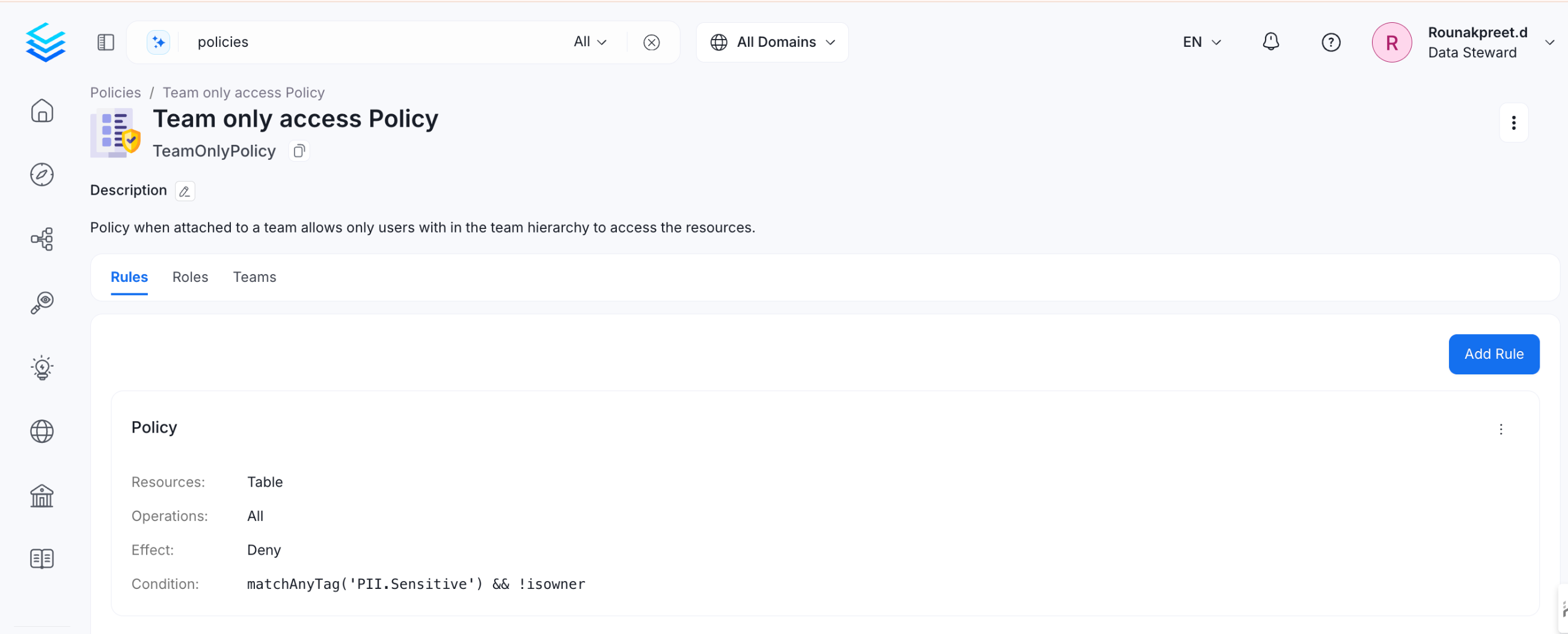
matchAllTags('PII.Sensitive') with isOwner() and matchTeam() conditions. All three are evaluated together – if the asset is tagged PII and the user has no ownership claim, access is denied.
Use Case 5: Set Up a Read-Only Viewer Role
Goal: Give business stakeholders access to browse the catalog and understand what data exists, without exposing raw data or query history. Create a policy with the following rules:
Create a
Read-Only Viewer role and assign this policy to it.
Note: Leave out
ViewSampleData, ViewUsage, and ViewQueries. A viewer needs to
understand what exists – not access raw data or behavioral analytics.Use Case 6: Set Up a Data Analyst Role
Goal: Give analysts full metadata visibility, query context, and the ability to enrich assets with descriptions and tags. Create a policy with the following rules:
Create a
Data Analyst role and assign this policy to it.
Note:
ViewSampleData is not included by default. If analysts need to preview row-level data, create a separate Analyst – Sample Data role and require manager approval before assigning it.Use Case 7: Set Up a Data Engineer Role
Goal: Give engineers full control over pipelines, ingestion, and data asset structure. Create a policy with the following rules:
Create a
Data Engineer role and assign this policy to it.
Note: Don’t include
EditPolicy, EditRole, or Delete on User and Team resources. Infrastructure access doesn’t require access control modification.Use Case 8: Scope a Role to a Specific Domain
Goal: Give a user analyst-level access within one domain – for example, Finance – without giving them access to assets in other domains. Create aData Analyst – Finance role. In the policy, set the resource to Table with a condition using matchAnyDomain('Finance'). Assign ViewAll, ViewUsage, and ViewQueries to this scoped policy.
Repeat this pattern for other domains as needed – for example, a Data Steward – Marketing role that can only edit tags and glossary terms within the Marketing domain.
This keeps permissions tight and limits the impact if a role is misconfigured.
Use Case 9: Set Up Temporary Elevated Access
Goal: Give a user short-term access to sensitive permissions – for example, during an incident or audit – without permanently changing their role.- Create a
Break-Glassrole that includesViewSampleDataandViewTestCaseFailedRowsSample. - Assign this role to the user temporarily with a defined end date.
- After the session, review Audit Logs to confirm what actions were taken.
- Remove the role assignment once the task is complete.
Related Pages
- Building Blocks of Authorization – Rules, Policies, and Roles – how rules, policies, and roles work
- Resource Scope and Operations Reference – reference guide for resources and operations