
Ontology
A glossary gives your organization agreed names and definitions. An ontology goes further: it records how those concepts relate — what is part of what, what is calculated from what, what is regulated by what — in a form software can act on. In OpenMetadata the ontology is built directly on the glossary you already have. Glossary terms become concepts, term relations become typed relationships backed by OWL/SKOS predicates, and the whole model can be authored, queried, imported, and exported from Ontology Studio. Open it from Govern → Ontology Studio.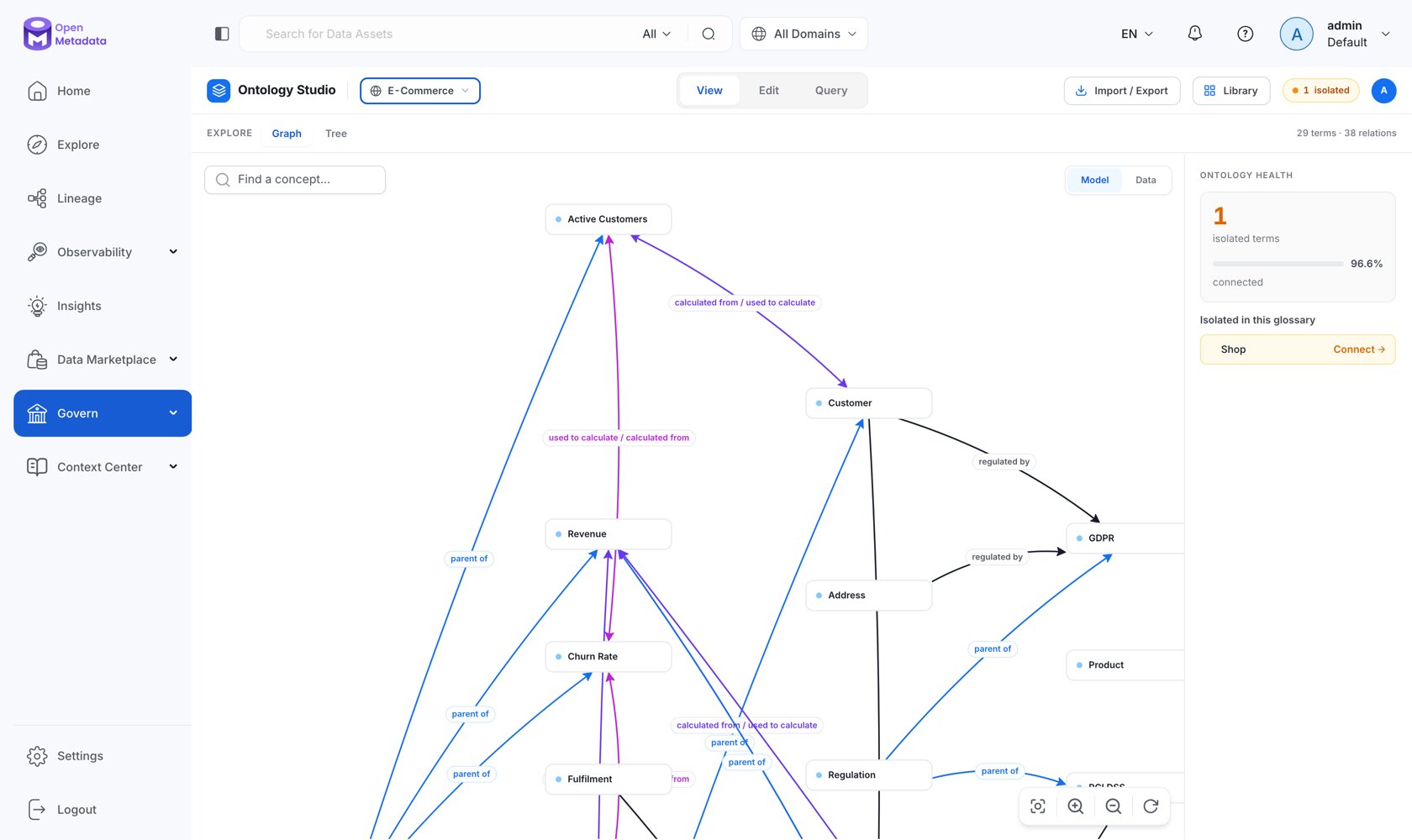
Where the Documentation Lives
The full guide is in its own section:Ontology & Knowledge Graph — Overview
What an ontology is, why it matters in the AI era, and how OpenMetadata implements it.
Core Concepts
Concepts, relationship types, attributes, axioms, IRIs, and ontology layers.
Ontology Studio
Explore, author, query, and AI-assist your model.
Knowledge Graph
The whole catalog as one RDF graph you can query with SPARQL.
Relationship Types
Govern the vocabulary of edges between concepts.
For AI Agents
MCP tools that let an assistant traverse the graph.
Related
Glossary
Create and organize the terms your ontology is built from.
Enable RDF (Knowledge Graph)
Deploy the triple store that unlocks SPARQL, reasoning, and the 3D graph.