Context Center
Overview
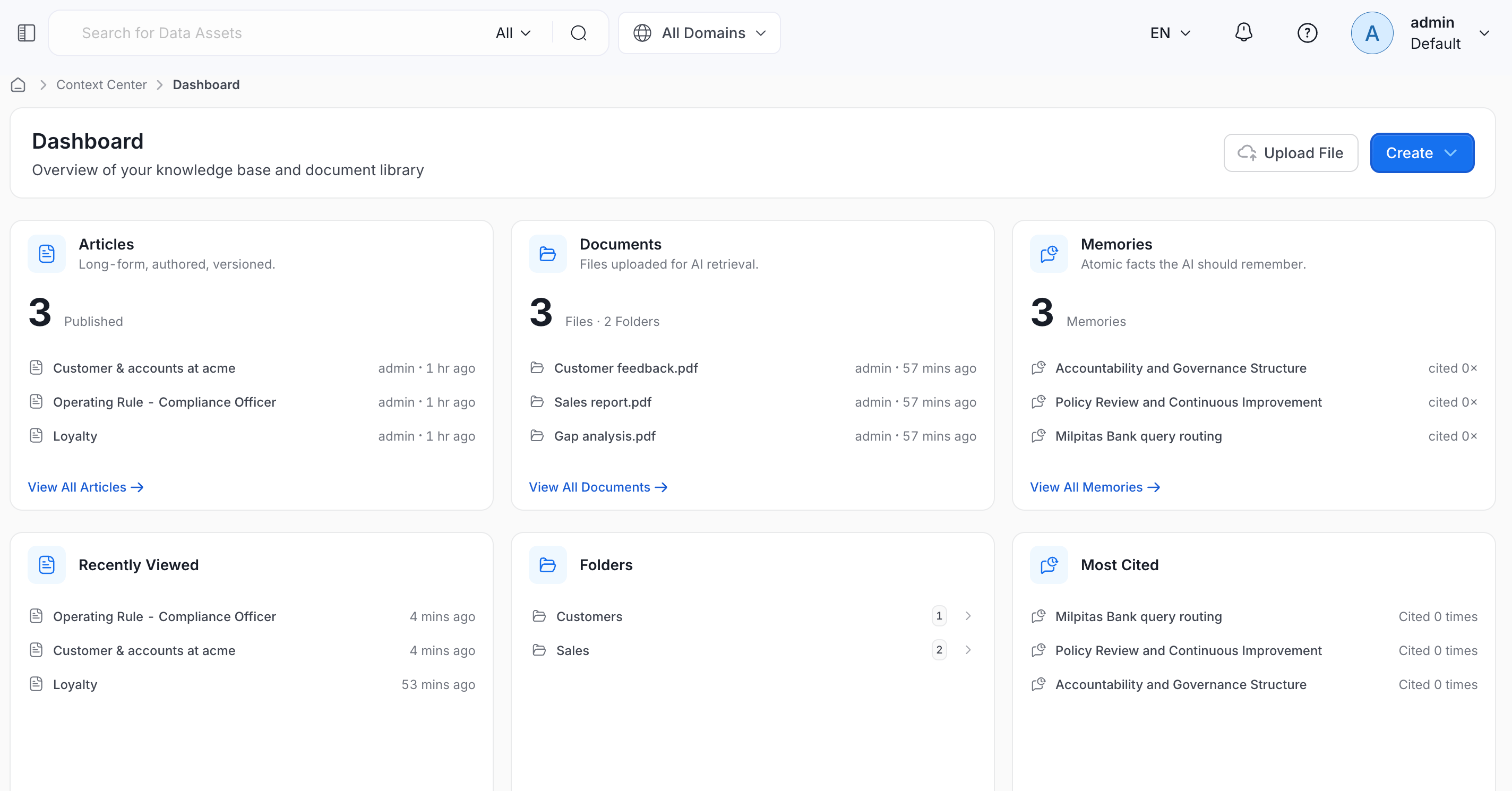
Context Center is a shared knowledge base for company context: Articles, Memories, and Documents. Open Context Center from the left sidebar to browse, create, and manage this content. MCP company-context search currently retrieves only shared knowledge pills that OpenMetadata extracts from uploaded files. It does not search Articles or manually created or remembered Memories.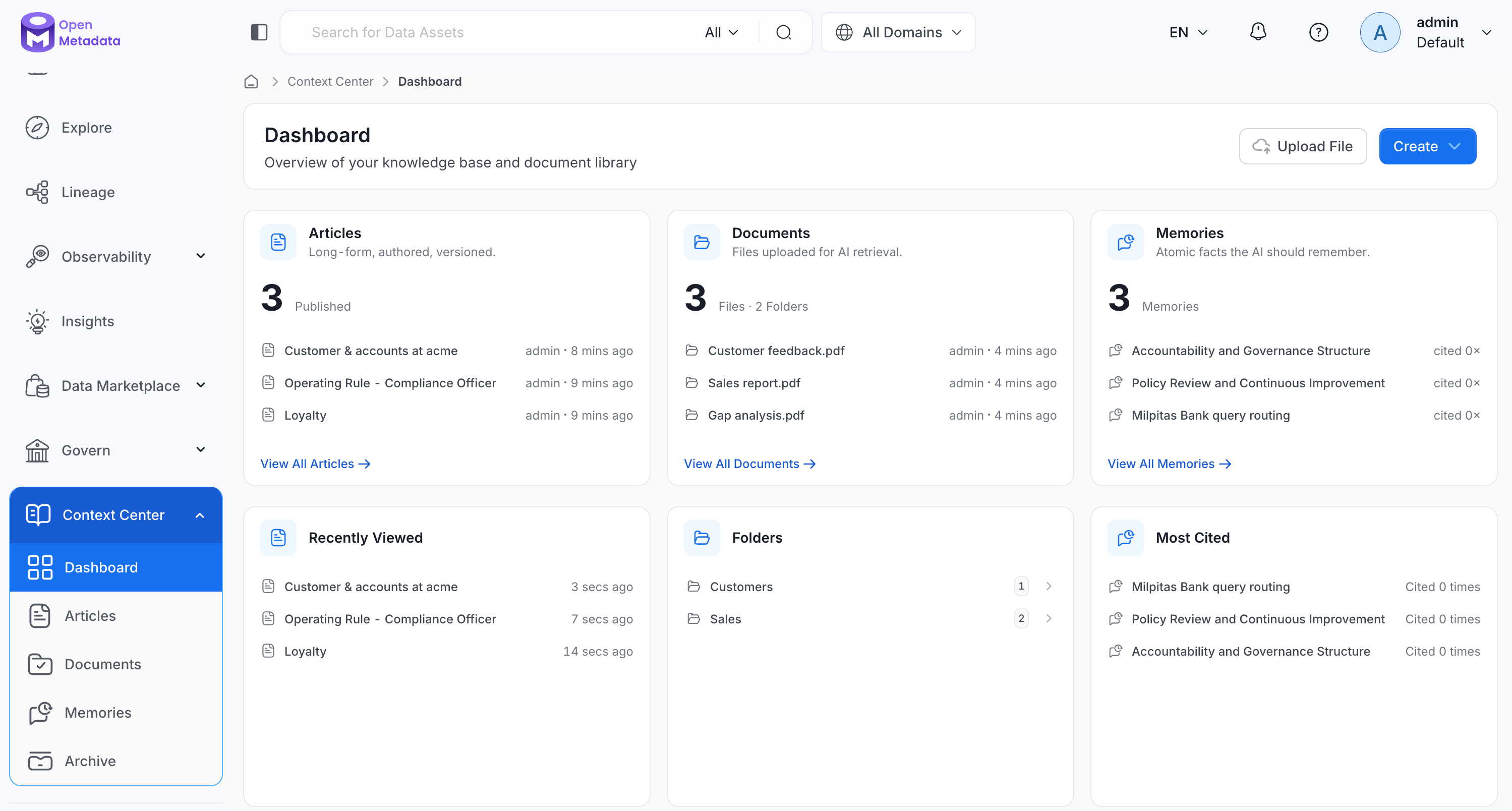
Purpose
Without Context Center, an AI assistant connected via MCP can only answer questions using what’s in your data catalog: table schemas, column descriptions, lineage, and so on. But a lot of what teams actually need to know lives outside the catalog: a written data governance policy, a runbook for handling a recurring incident, an internal definition of a business metric, or a preference one person has for how they like answers formatted. Context Center gives that knowledge a home. After OpenMetadata extracts an uploaded file into shared knowledge pills, thesearch_company_context and get_company_context MCP tools can use those pills alongside catalog metadata. Articles and Memories support people and application workflows, but those tools do not currently return them.
How to Use
Context Center holds three kinds of content, each suited to a different kind of knowledge:- Articles: Long-form pages your team writes and maintains, such as policies, playbooks, and internal documentation.
- Memories: Short, atomic facts, such as preferences, runbook steps, and FAQs, created either by an AI assistant during a conversation or manually by a user.
- Documents: Files organized into folders. MCP search can retrieve shared knowledge pills OpenMetadata extracts from uploaded files.
When to Use
- Writing or maintaining a policy, standard, or how-to guide that people should be able to find and reference: use an Article.
- Capturing a quick fact, preference, or answer to a recurring question that doesn’t need a full page: create a Memory.
- Making an existing file, such as a PDF report, a spreadsheet, or a compliance audit, available to MCP search when OpenMetadata extracts shared knowledge pills from it: upload it as a Document.
Dashboard
Opening Context Center takes you to its Dashboard, an at-a-glance summary of everything in your knowledge base.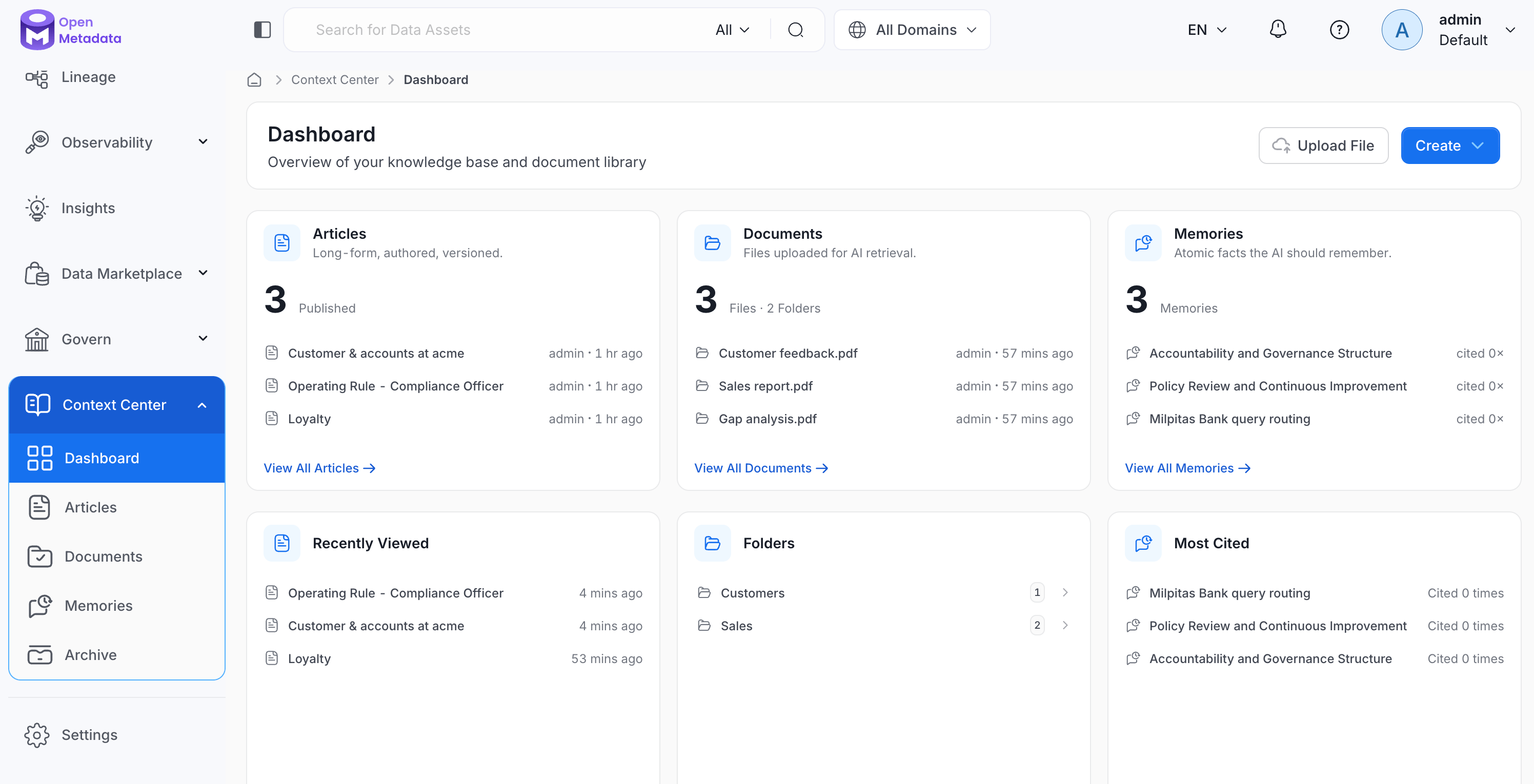
- Articles, Documents, and Memories: One card per content type, each showing a short description of what it holds, a total count (for example,
3 Publishedor3 Files · 2 Folders), and its three most recent items with author and last-edited time. Click View All on any card to open that section’s full list. - Recently Viewed: The items you opened most recently across all content types, newest first.
- Folders: The folders you’ve created to organize Documents, each showing how many files it contains.
- Most Cited: Your Memories ranked by citation count, shown as
Cited N times.